FutureWorld Climate Intelligence Principle

#002 Climate Cycles and Human Forcing

Climate Intelligence must explain natural climate cycles while clearly distinguishing them from today’s rapid human-driven warming caused mainly by greenhouse-gas emissions.

Foundation PrincipleNatural VariabilityHuman ForcingEvidence-Based Communication

FWI publication information

Identity, scope and status

Retrospective validation pending
Publication family
Principles and Explainers
Publication type
FWI Key Principle / Research Explainer
Domain
Climate Intelligence
Series and number
Climate Principle #002
Institutional author
FutureWorld Intelligence
Publication year
Not recorded
Current web edition
1.0
Metadata updated
15 July 2026
Purpose
Explain a core climate concept, standard or implementation principle
Intended audience
Students, practitioners, communities, policymakers and public readers
Method and evidence basis
Source-grounded conceptual and policy synthesis
Evidence cut-off
The exact historical evidence cut-off was not recorded when the original web publication was prepared. Source currency will be confirmed during retrospective validation.
Limitations and disclosures
Classification and metadata do not independently validate substantive claims. Citation, factual, originality, AI-use, rights and conflict-of-interest checks remain part of the pending retrospective validation.

Validation note: This classification does not itself validate the publication. Retrospective factual, citation, originality, disclosure and readiness checks must be completed and human-approved before the status can change to “Validated — human approved.”

Recommended citation

FutureWorld Intelligence. (n.d.). #002 Climate Cycles and Human Forcing (Climate Principle #002; Web edition 1.0). https://futureworldintelligence.org/content/climate/principles/climate-cycles-human-forcing/

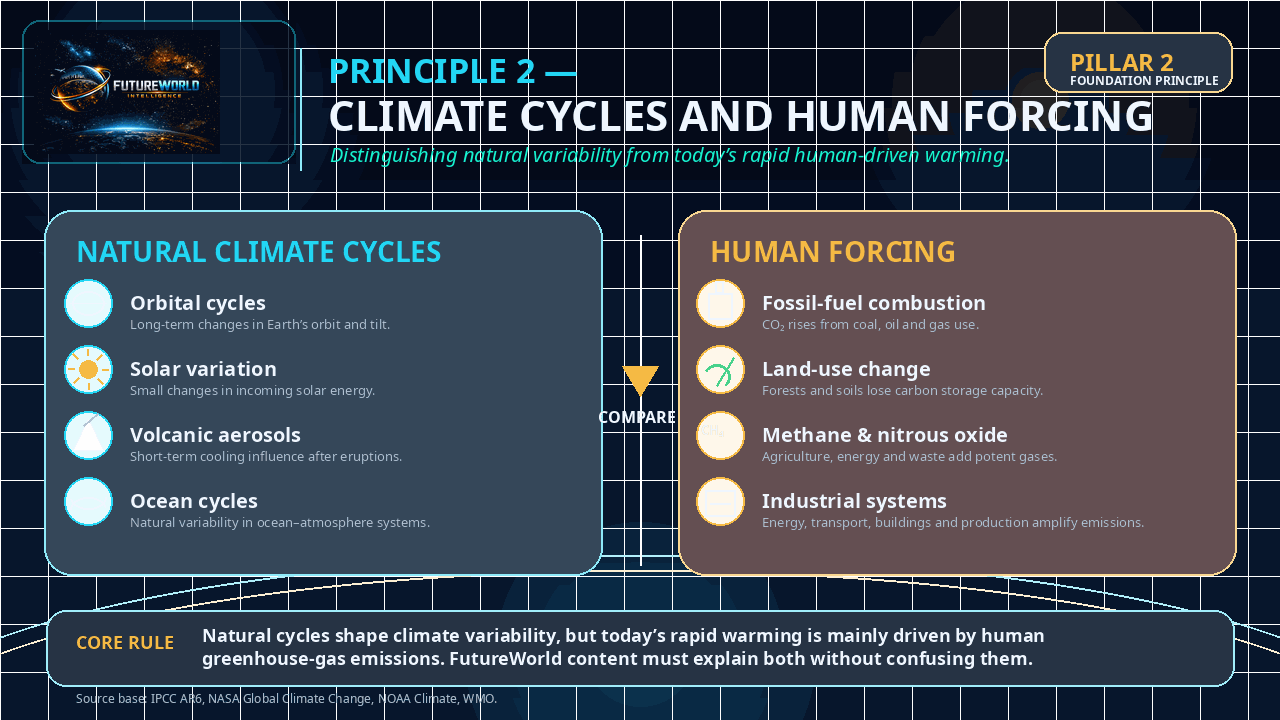
Natural climate cycles versus human forcing infographic
Visual 1: Natural climate cycles versus human forcing. This is an original FutureWorld editorial infographic based on official climate science sources; it is not an official agency graphic.

Why this principle matters

Climate change discussions often become confused when natural climate cycles are used to dismiss human-caused warming. This principle prevents that mistake. It accepts that natural cycles exist, but it also explains why the current warming trend is different in speed, scale and cause.

Natural variability influences climate over seasonal, decadal and long-term geological timescales. Human forcing, especially the rise of greenhouse gases from fossil fuels and land-use change, has added a powerful warming influence to the Earth system.
Core rule

Never deny natural climate cycles, but never use them to hide human forcing. FutureWorld climate content must explain both clearly, then connect evidence to practical action.

This protects the platform from climate misinformation and helps readers understand why climate action is still necessary even though the planet has natural cycles.

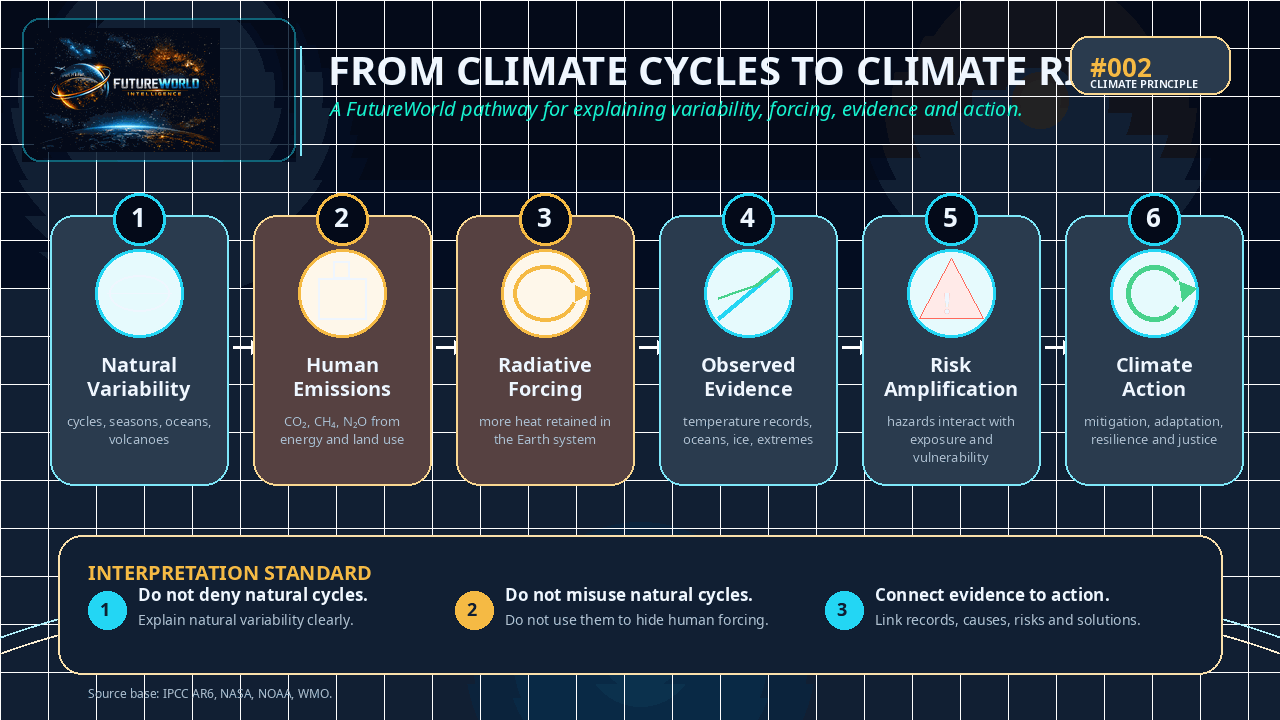
1The explanation pathway

A standard FutureWorld explanation of climate cycles and human forcing should move through five stages.

Natural variabilityExplain orbital cycles, solar variation, volcanic aerosols and ocean-atmosphere variability as real features of Earth’s climate system.
Human emissionsExplain carbon dioxide, methane and nitrous oxide emissions from fossil fuels, land-use change, agriculture, waste and industrial systems.
Radiative forcingExplain how added greenhouse gases retain more heat in the Earth system, changing the planet’s energy balance.
Observed evidenceConnect the explanation to temperature records, ocean heat, ice loss, sea-level rise and changing extremes.
Climate actionTranslate understanding into mitigation, adaptation, disaster-risk reduction, early warning, nature-based resilience and just transition.
Climate cycles to climate risk pathway infographic
Visual 2: From climate cycles to climate risk. This pathway shows how variability, emissions, forcing, evidence, risk and action connect.

2What it teaches

  • Natural climate cycles are real and should be explained honestly.
  • Natural cycles alone do not explain today’s rapid global warming trend.
  • Human greenhouse-gas emissions have changed the Earth’s energy balance.
  • Climate risk grows when hazards interact with exposure and vulnerability.
  • Good climate communication must move from causes to evidence, then to action.

3FutureWorld application

For FutureWorld Intelligence, this principle becomes a safeguard against weak climate explanations. It supports articles, maps, AI dashboards, school resources and field briefings that explain both natural variability and human-caused warming in a balanced but scientifically clear way.

For local climate action, this principle helps communities understand why drought, heat, floods, fire risk and watershed stress must be treated as both natural-risk and human-amplified challenges.

Website-ready source notes

IPCC AR6 Synthesis Report: Use for human-caused warming, greenhouse-gas emissions, observed changes and the need for mitigation and adaptation. Open source
NASA Global Climate Change: Use for explaining natural and human causes of climate change, the greenhouse effect and observed climate indicators. Open source
NOAA Climate: Use for climate forcing, greenhouse gases, carbon dioxide records and climate variability explanation. Open source
WMO Climate Information: Use for state-of-climate reporting, observed warming, climate indicators and early warning context. Open source

Final takeaway

Climate cycles explain natural variability. Human forcing explains why today’s warming is accelerating beyond normal background variability. FutureWorld Climate Intelligence should teach both clearly so that public understanding leads to responsible climate action.