FutureWorld Climate Intelligence Principle

#001 Historical Climate Literacy

Climate Intelligence begins with historical literacy: understanding how climate science, global governance, climate finance and implementation frameworks evolved into today’s climate action system.

Foundation PrincipleScience to GovernanceParis • COP • GCF • SDGsImplementation Era

FWI publication information

Identity, scope and status

Retrospective validation pending
Publication family
Principles and Explainers
Publication type
FWI Key Principle / Research Explainer
Domain
Climate Intelligence
Series and number
Climate Principle #001
Institutional author
FutureWorld Intelligence
Publication year
Not recorded
Current web edition
1.0
Metadata updated
15 July 2026
Purpose
Explain a core climate concept, standard or implementation principle
Intended audience
Students, practitioners, communities, policymakers and public readers
Method and evidence basis
Source-grounded conceptual and policy synthesis
Evidence cut-off
The exact historical evidence cut-off was not recorded when the original web publication was prepared. Source currency will be confirmed during retrospective validation.
Limitations and disclosures
Classification and metadata do not independently validate substantive claims. Citation, factual, originality, AI-use, rights and conflict-of-interest checks remain part of the pending retrospective validation.

Validation note: This classification does not itself validate the publication. Retrospective factual, citation, originality, disclosure and readiness checks must be completed and human-approved before the status can change to “Validated — human approved.”

Recommended citation

FutureWorld Intelligence. (n.d.). #001 Historical Climate Literacy (Climate Principle #001; Web edition 1.0). https://futureworldintelligence.org/content/climate/principles/historical-climate-literacy/

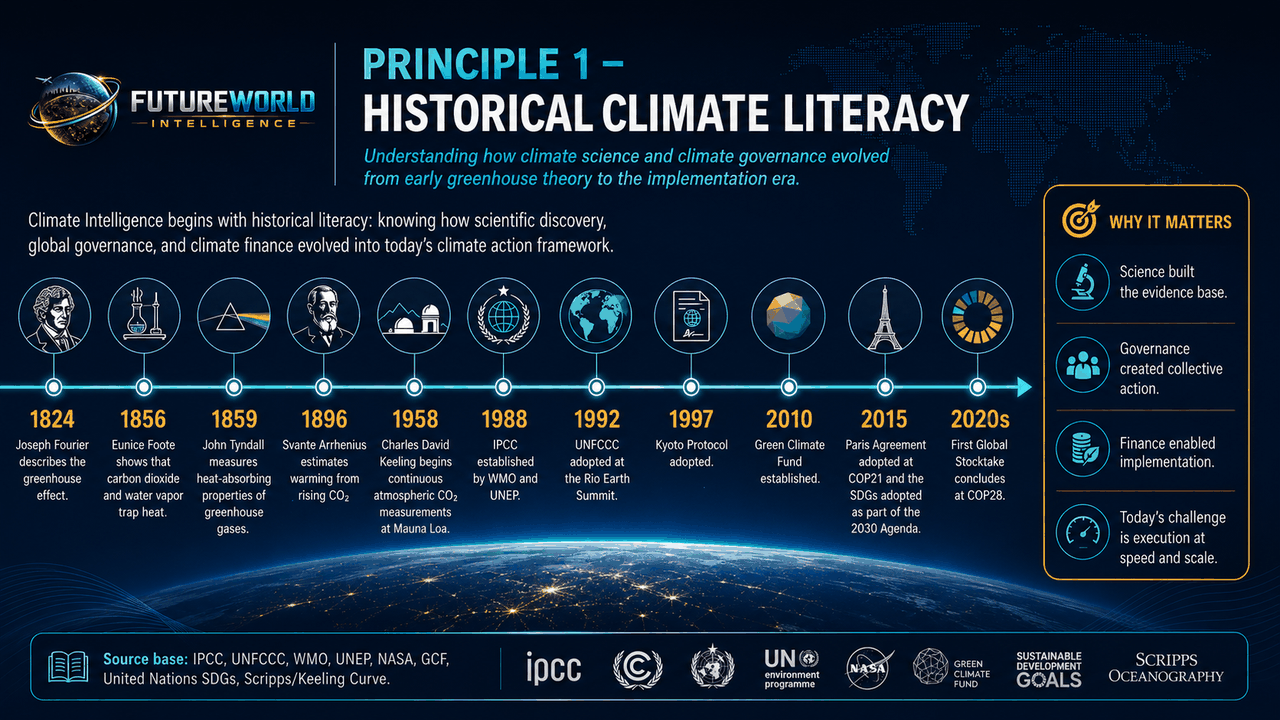
Historical Climate Literacy timeline infographic
Visual 1: Historical Climate Literacy timeline. This is an original FutureWorld editorial infographic based on official climate science and governance sources; it is not an official agency graphic.

Why this principle matters

Climate change is often discussed as if it appeared suddenly. Historical Climate Literacy corrects that mistake. It shows that climate action is the result of two centuries of scientific discovery, decades of atmospheric monitoring, and a long process of international cooperation.

From early greenhouse theory to the Keeling Curve, from the creation of the IPCC to the UNFCCC, Kyoto Protocol, Paris Agreement, Green Climate Fund and SDGs, the climate field has moved from discovery to evidence, governance, finance and implementation.
Core rule

Every FutureWorld climate report, map, video, AI dashboard or field intervention should explain where its climate knowledge comes from, what global framework it connects to, and how that knowledge supports action.

This protects the platform from weak claims, misinformation and disconnected advocacy. It also helps readers understand that climate action is not only environmental passion; it is science-backed public policy.

1The historical pathway

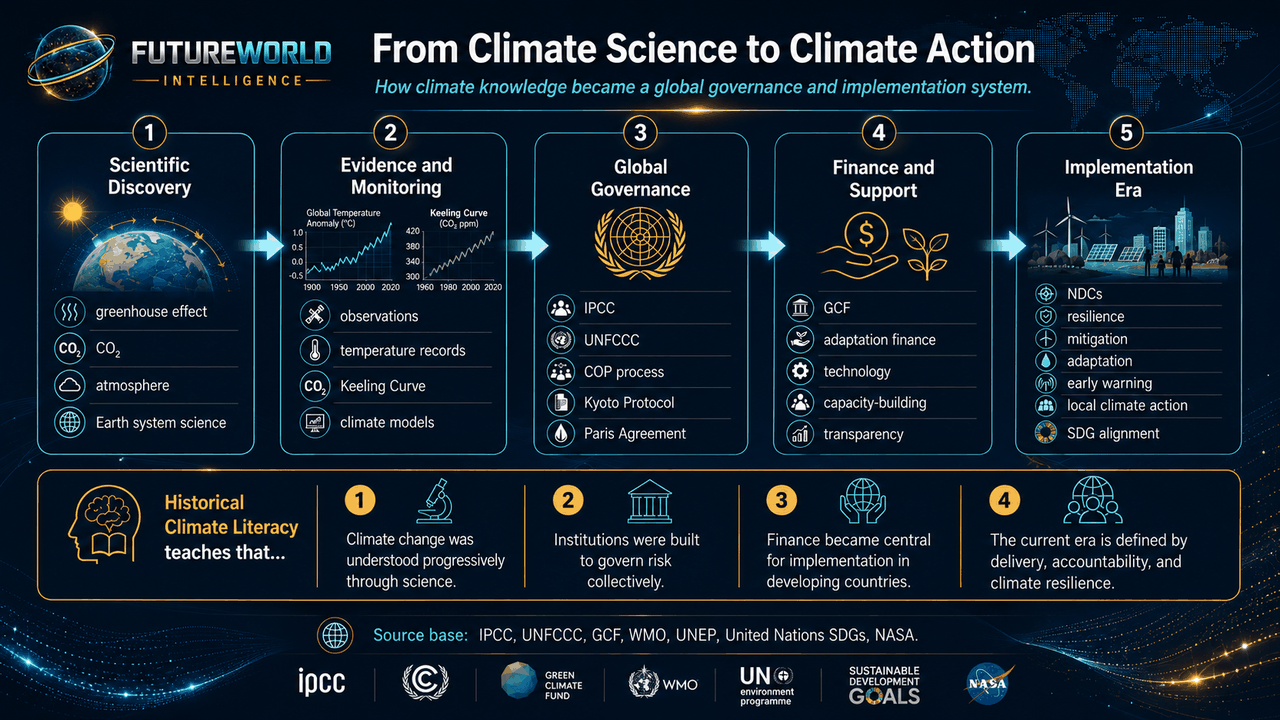
A standard FutureWorld reading of historical climate literacy should move through five stages.

ScienceEarly researchers identified the greenhouse effect and the heat-trapping role of atmospheric gases. This created the scientific foundation for modern climate knowledge.
EvidenceContinuous measurements, temperature records and climate models turned theory into monitored evidence. The Keeling Curve became one of the clearest symbols of rising atmospheric carbon dioxide.
GovernanceThe IPCC, UNFCCC, COP process, Kyoto Protocol and Paris Agreement transformed climate knowledge into global cooperation and negotiated responsibility.
FinanceClimate finance became central because developing countries need support for mitigation, adaptation, technology, capacity-building and resilience.
ImplementationThe current era is defined by delivery: NDCs, transparency, adaptation, early warning, just transition, SDG alignment and local climate action.
From climate science to climate action infographic
Visual 2: From climate science to climate action. This flow visual shows how discovery, monitoring, governance, finance and implementation connect.

2What it teaches

  • Climate change was understood progressively through science, not through opinion.
  • Scientific evidence became stronger through monitoring, records and assessments.
  • Global institutions were created because climate risk cannot be solved by one country alone.
  • Finance, technology and capacity-building became central for developing-country implementation.
  • The present challenge is not only awareness; it is execution at speed, scale and fairness.

3FutureWorld application

For FutureWorld Intelligence, Historical Climate Literacy becomes the first discipline of climate communication. It means every article should show the reader the scientific lineage, the policy framework and the action pathway.

For field work, this principle links global climate frameworks with local implementation. A watershed restoration activity, assisted natural regeneration enclosure, fire awareness campaign, early warning dashboard or AI monitoring tool should be explained as part of the larger climate action system.

Website-ready source notes

IPCC AR6 Synthesis Report: IPCC states that human activities, principally through greenhouse-gas emissions, have unequivocally caused global warming, and that climate-resilient development integrates mitigation and adaptation. Open source
IPCC History: IPCC was established in 1988 by UNEP and WMO to provide policymakers with regular scientific assessments on climate change. Open source
UNFCCC Paris Agreement: The Paris Agreement is a legally binding international treaty adopted at COP21 in 2015, with the goal of holding warming well below 2°C and pursuing 1.5°C. Open source
Green Climate Fund: GCF describes itself as the world’s climate fund for developing countries, investing in low-emission and climate-resilient pathways. Open source
United Nations SDGs: The 2030 Agenda and 17 SDGs provide a shared blueprint for peace and prosperity for people and the planet. Open source
Scripps Keeling Curve: Use for atmospheric CO₂ monitoring context and long-term evidence building. Open source

Final takeaway

Historical Climate Literacy teaches that climate action is not a slogan. It is a long chain of science, observation, institutions, finance and implementation. The task now is to bring that chain into the field: into watersheds, forests, communities, early warning systems, AI tools and local climate resilience.