FWI publication information

Identity, scope and status

Retrospective validation pending
Publication family
Research and Strategic Analysis
Publication type
FWI Foresight & Scenario Report
Domain
Strategic Futures
Series and number
Force No. 5
Institutional author
FutureWorld Intelligence
Publication year
Not recorded
Current web edition
1.0
Metadata updated
15 July 2026
Purpose
Deliver source-grounded strategic analysis of a major force shaping systems toward 2035
Intended audience
Policymakers, researchers, professionals and informed public
Method and evidence basis
Desk-based evidence synthesis and strategic systems analysis
Evidence cut-off
The exact historical evidence cut-off was not recorded when the original web publication was prepared. Source currency will be confirmed during retrospective validation.
Limitations and disclosures
Classification and metadata do not independently validate substantive claims. Citation, factual, originality, AI-use, rights and conflict-of-interest checks remain part of the pending retrospective validation.

Validation note: This classification does not itself validate the publication. Retrospective factual, citation, originality, disclosure and readiness checks must be completed and human-approved before the status can change to “Validated — human approved.”

Recommended citation

FutureWorld Intelligence. (n.d.). Force No. 5: Strategic Futures (Force No. 5; Web edition 1.0). https://futureworldintelligence.org/content/futures/strategic-futures-foresight-resilience-governance-shaping-2035/

FutureWorld Intelligence logo

FutureWorld Intelligence Report Series

The Five Forces Shaping the Future Toward 2035

Force No. 5: Strategic Futures

The Foresight, Resilience and Governance Capacity Shaping the World Toward 2035

Evidence-Based Strategic and Policy BriefingReport date: June 2026Capstone Force Report
Force No. 5 Strategic Futures cover visual

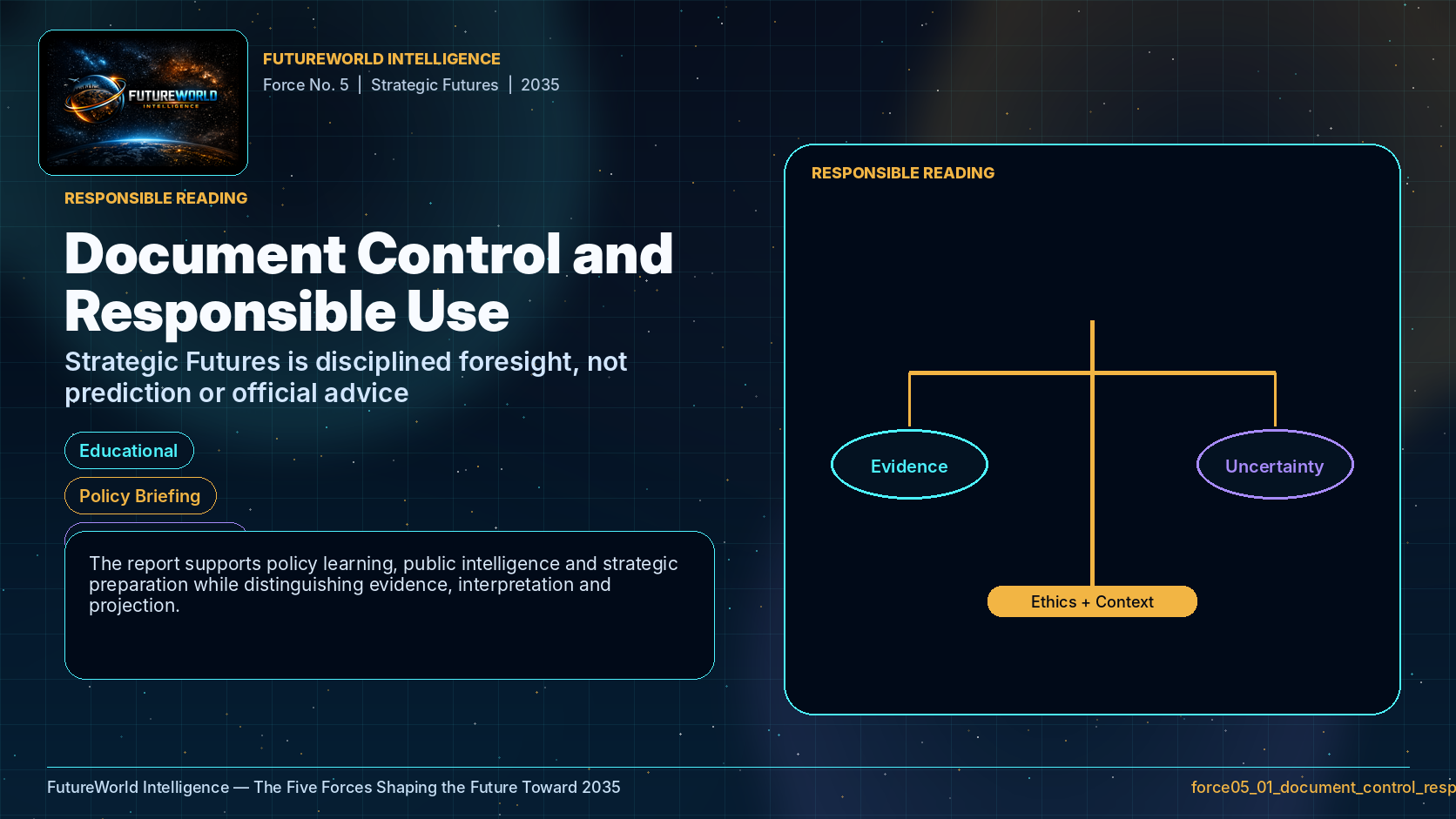
Document Control and Responsible Use Statement

Document control and responsible use: transparent purpose, evidence boundaries and responsible strategic reading.
Figure 1. Document control and responsible use: transparent purpose, evidence boundaries and responsible strategic reading.

This report is prepared for educational, policy-briefing, public-intelligence and strategic-foresight purposes. It is intended for policymakers, public-sector officials, researchers, students, development practitioners, civil-society organizations, educators, journalists, climate professionals, technology observers, planners and strategic decision-makers seeking to understand why strategic futures capacity is one of the principal forces shaping the world toward 2035.

This report is not a prediction of a single future. It is not diplomatic, investment, security, legal, engineering, or emergency-management advice. It does not represent the official position of any government, multilateral institution, university, corporation, donor agency or research body named within it.

The report uses the term Strategic Futures in a systems-policy sense: the structured capacity of societies, institutions, governments, businesses and communities to anticipate disruption, interpret weak signals, build scenarios, prepare institutions, protect vulnerable populations, govern uncertainty and shape long-term outcomes.

Strategic Futures is not fortune-telling. It is disciplined foresight. It does not claim to know exactly what will happen. It helps decision-makers prepare for multiple plausible futures before crises become irreversible.

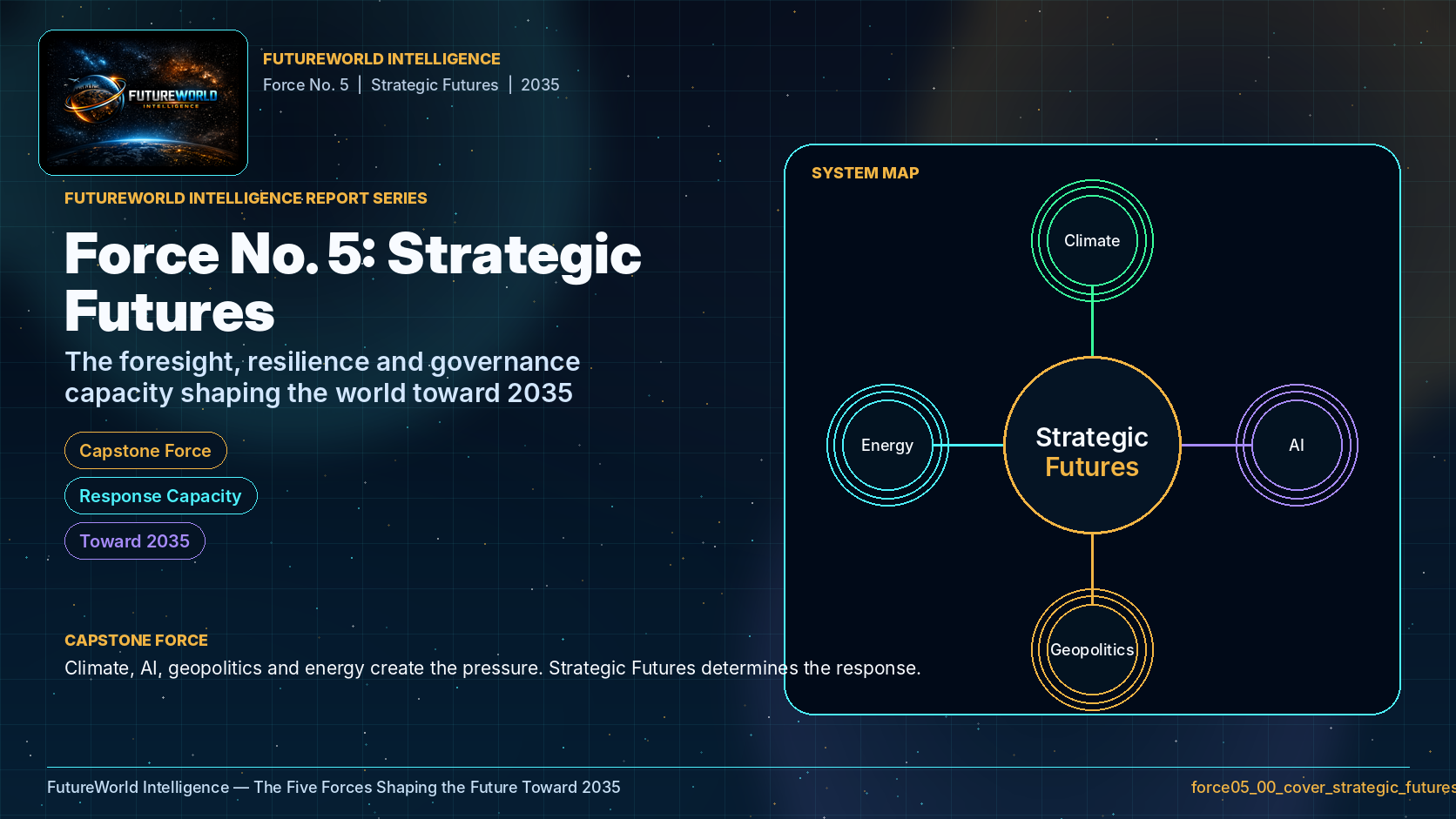
This report treats Strategic Futures as the fifth force in the FutureWorld Intelligence series because the first four forces — Climate Change, Artificial Intelligence, Geopolitics and Energy Transition — create the pressure. Strategic Futures determines the response.
Executive Summary

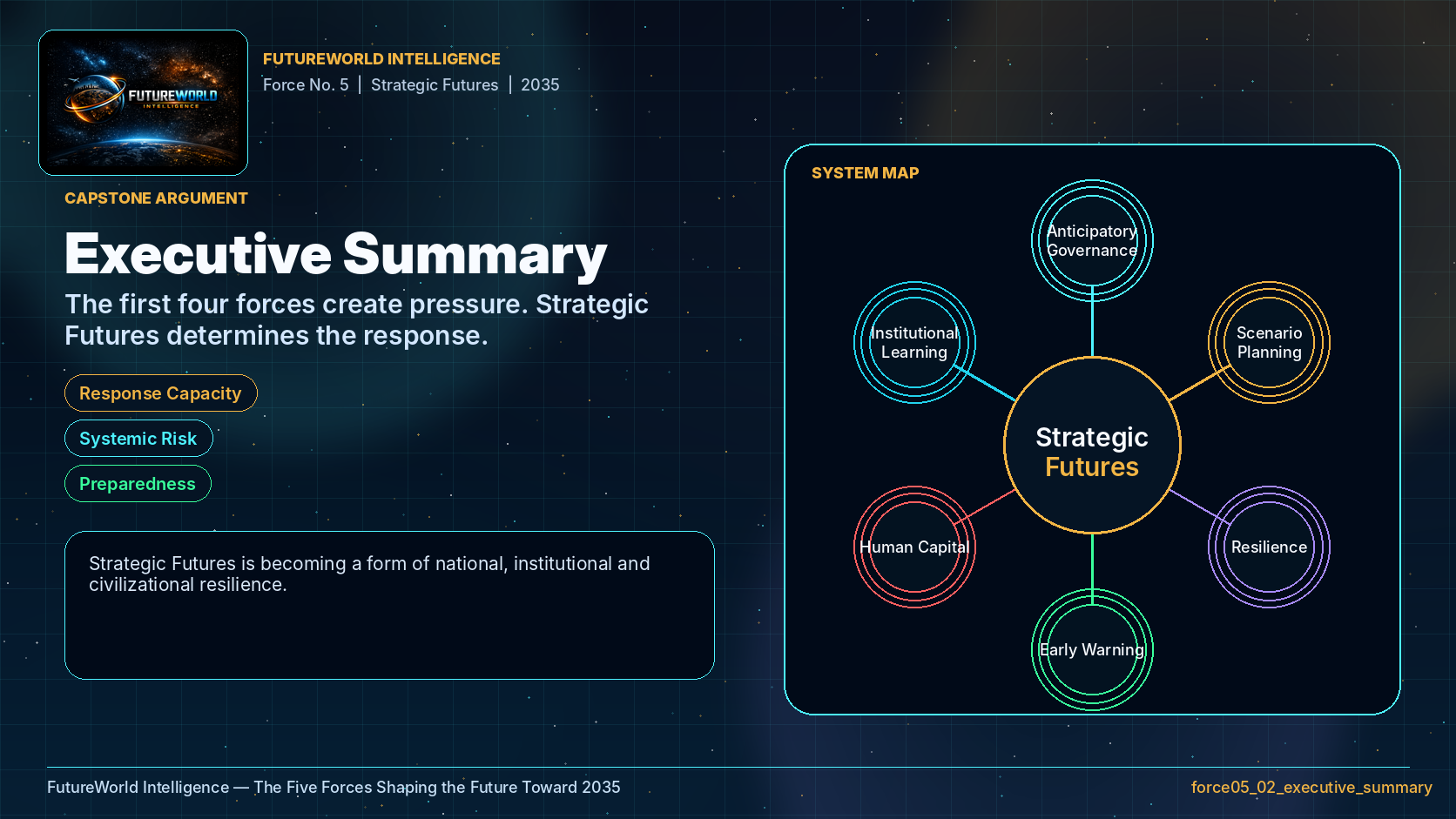
Strategic Futures as the capstone response capacity connecting climate, AI, geopolitics and energy transition.
Figure 2. Strategic Futures as the capstone response capacity connecting climate, AI, geopolitics and energy transition.

Strategic Futures is one of the principal forces shaping the world toward 2035 because the future will not be determined only by climate change, artificial intelligence, geopolitics or energy transition. It will also be determined by the capacity of societies to understand those forces early, prepare institutions, adapt systems, protect citizens and make better decisions under uncertainty.

The central argument of this report is that foresight capacity is becoming a form of national, institutional and civilizational resilience. Countries, organizations and communities that can anticipate complex change will be better positioned than those that respond only after disruption has already arrived.

The first four forces in this series describe the external pressures reshaping the global system.

Climate change is altering the physical baseline of human development through heat, floods, droughts, storms, food insecurity, biodiversity loss, water stress and adaptation pressure.

Artificial intelligence is altering the cognitive and institutional baseline by transforming knowledge work, decision-making, education, media, security, scientific research, public administration and the structure of digital power.

Geopolitics is altering the power baseline through fragmented multipolarity, strategic competition, military expenditure, maritime chokepoints, sanctions, supply-chain insecurity, technology rivalry and forced displacement.

Energy transition is altering the infrastructure baseline through electrification, renewable power, grids, storage, critical minerals, energy finance, industrial competitiveness and energy-security realignment.

Strategic Futures is different. It is not another external shock. It is the response capacity that determines whether societies are overwhelmed by these forces or prepared enough to shape them.

This report argues that Strategic Futures will shape the future through six pathways: anticipatory governance, scenario planning, resilience building, early-warning systems, human-capital readiness and institutional learning.

Evidence from the global risk environment supports this argument. The World Economic Forum’s 2026 Global Risks work highlights the growing relevance of economic confrontation, environmental risks and AI governance over different time horizons. SIPRI reports that global military expenditure reached approximately US$2.718 trillion in 2024, showing a more securitized world. UNHCR reporting shows forced displacement above 120 million people in recent years, demonstrating the human consequences of conflict and fragility. IRENA-linked 2026 data show global renewable capacity reaching 5,149 GW by the end of 2025, confirming the scale of infrastructure transformation under way. These are not isolated statistics. They are signals of systemic transition.

The strategic lesson is clear: the future is becoming more interconnected, faster moving and more difficult to manage through reactive governance alone.

By 2035, the most prepared societies will not necessarily be those with the largest populations, the richest resource base, or the strongest military alone. They will be those with the strongest anticipatory intelligence capacity: the ability to identify emerging risks, interpret system interactions, prepare public institutions, educate citizens, mobilize finance, protect critical infrastructure and sustain public trust.

Strategic Futures is therefore not a luxury discipline. It is becoming core policy infrastructure.


1. Core Thesis: Why Strategic Futures Qualifies as a Future-Shaping Force

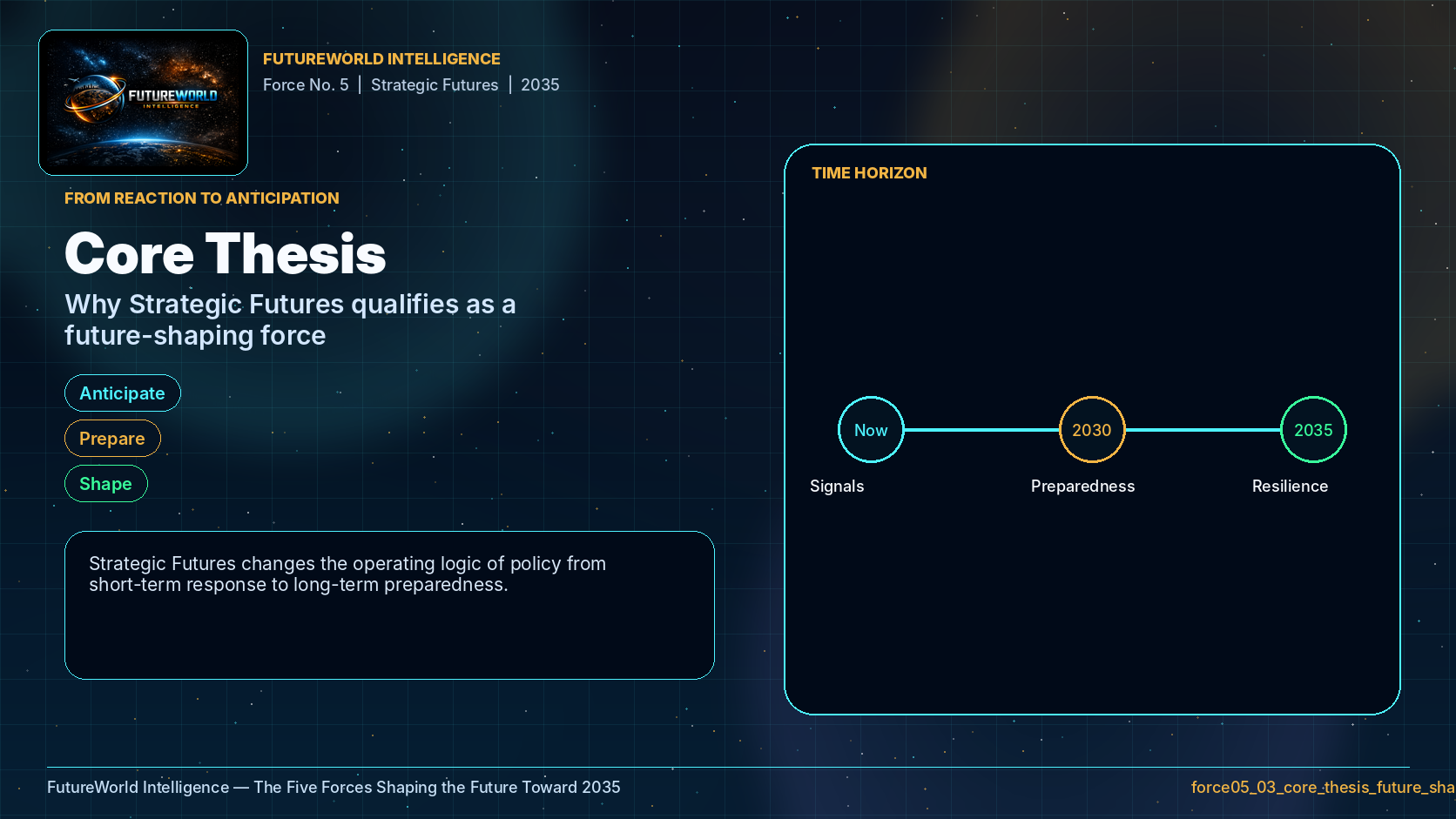
Strategic Futures changes the operating logic of policy from reaction to anticipation.
Figure 3. Strategic Futures changes the operating logic of policy from reaction to anticipation.

Strategic Futures qualifies as a future-shaping force because it determines how societies respond to uncertainty before uncertainty becomes crisis.

A force shapes the future when it reorganizes decisions, institutions, investment, education, infrastructure, governance and public behaviour. Strategic Futures does this by changing the way societies think about time.

Most governance systems are designed for the present. Budgets are annual. Political cycles are short. Departments work in silos. Emergency response often begins after visible damage. Development planning is frequently linear. Risk registers are often static. Public institutions may identify problems only after they have already become politically costly.

The world toward 2035 will punish that model.

Climate shocks will not pause for budget cycles. AI disruption will not hold back while education systems reform. Geopolitical crises will not delay for supply chains to diversify. Energy transition will not stand by for outdated grids to modernize. Social instability will not linger until institutions rebuild public trust.

Strategic Futures shifts governance from reaction to anticipation.

It asks not only, “What is happening now?” but also:

  • What weak signals are emerging?
  • Which systems are interacting?
  • Which risks could cascade?
  • Which populations are most vulnerable?
  • Which institutions are unprepared?
  • Which decisions must be made before full certainty exists?
  • Which capabilities are needed by 2030 and 2035?
  • Which futures should be avoided, and which futures should be built?

This makes Strategic Futures a force because it changes the operating logic of policy. It moves decision-making from short-term response to long-term preparedness.

In strategic terms, the countries and institutions that develop foresight capacity will be better positioned to manage risk, seize opportunity and avoid costly surprise. Those that fail to develop it may face repeated crisis cycles: disaster, response, recovery, debt, instability and delayed reform.

Strategic Futures is not about predicting one future. It is about building the capacity to operate across several plausible futures.


2. From Prediction to Preparedness: Institutional Support and Global Practice

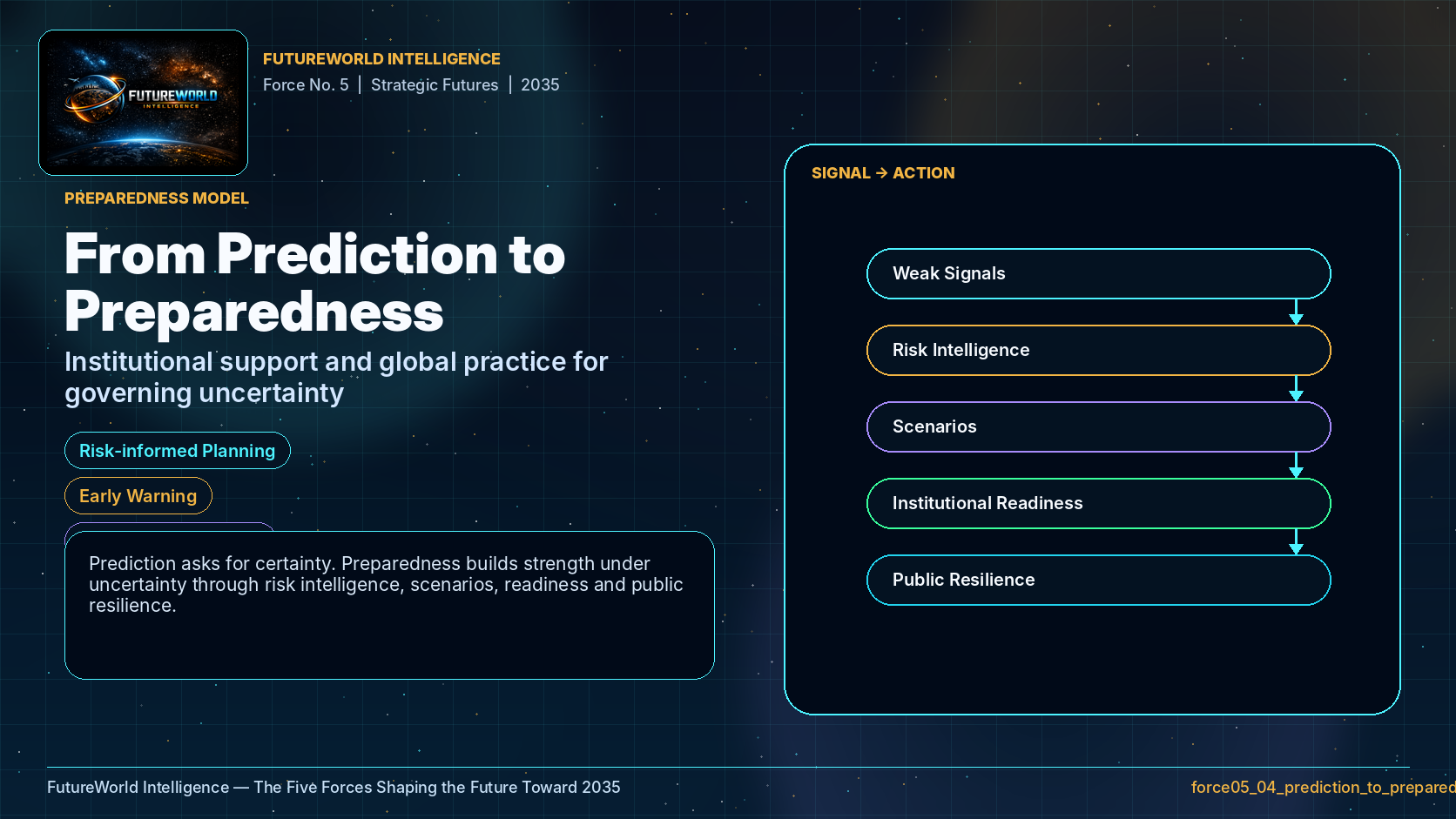
From prediction to preparedness: risk intelligence, scenarios, institutional readiness and public resilience.
Figure 4. From prediction to preparedness: risk intelligence, scenarios, institutional readiness and public resilience.

The old model of future thinking often focused on prediction. It asked: what will happen?

The new model must focus on preparedness. It asks: what could happen, what would it mean, and what should we do now?

This distinction is important.

Prediction assumes that the future can be forecast with sufficient accuracy. Preparedness assumes that the future is uncertain, but that uncertainty can still be governed. Strategic Futures does not require perfect certainty. It requires disciplined imagination, evidence-based analysis, institutional learning and adaptive response.

This shift is already reflected in global preparedness frameworks. The Sendai Framework for Disaster Risk Reduction calls for reducing disaster mortality, economic loss and infrastructure damage through anticipatory planning and early warning. The Paris Agreement emphasizes adaptation planning, resilience-building and climate-risk integration into national policy. The Sustainable Development Goals embed preparedness across health, food systems, infrastructure, governance and inequality reduction. Together, these global agendas signal a transition from reactive crisis management to proactive resilience-building.

This is especially important in an age of systemic risk.

Systemic risks do not remain confined to one sector. A climate shock can become a food-price shock. A food-price shock can become social unrest. Social unrest can weaken governance. Weak governance can deepen geopolitical vulnerability. Geopolitical disruption can affect energy supply. Energy stress can affect inflation. Inflation can affect public trust. Public distrust can weaken the ability of institutions to respond to the next crisis.

Global preparedness goals increasingly recognize these cascading risks. International efforts now emphasize multi-hazard early warning systems for all populations, resilient food systems under climate stress, pandemic preparedness through strengthened health systems, and secure, diversified energy and supply chains. These goals reflect an understanding that resilience must be systemic, not sectoral.

This is why Strategic Futures must be treated as a public-policy capability, not only as an academic exercise.

Preparedness requires four capacities.

First is risk intelligence: the ability to identify and interpret emerging risks before they mature, aligned with global commitments to risk-informed planning and data-driven early warning.

Second is scenario capacity: the ability to develop multiple plausible pathways and test decisions against them, consistent with international guidance on stress-testing policies under climate, economic and technological uncertainty.

Third is institutional readiness: the ability to align laws, budgets, departments, skills and leadership before disruption becomes severe, reflecting global calls for whole-of-government resilience and integrated national adaptation planning.

Fourth is public resilience: the ability of citizens, communities and local institutions to understand change, absorb shocks and participate in adaptation, in line with global goals to ensure inclusive resilience, community-based preparedness and universal access to early warning systems.

Prediction asks for certainty. Preparedness builds strength under uncertainty.

By 2035, preparedness may become one of the most important differences between resilient and fragile societies, as countries that align with global preparedness goals—early warning for all, climate-resilient infrastructure, adaptive governance, and inclusive human development—will be better positioned to manage uncertainty and shape stable futures.


3. The Four Forces as Interacting Systems

The first four forces create the pressure environment; Strategic Futures determines the response.
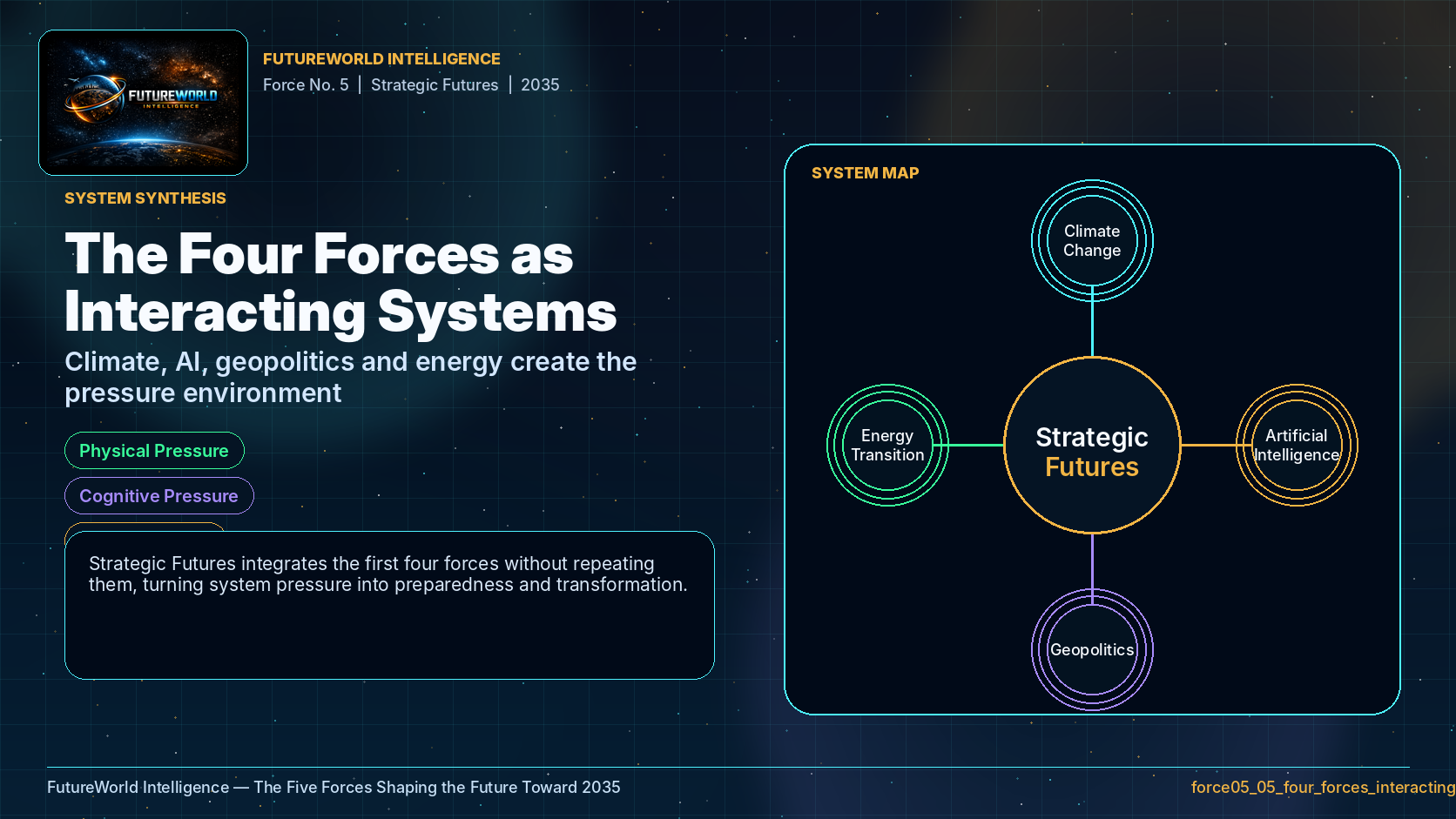
Figure 5. The first four forces create the pressure environment; Strategic Futures determines the response.
Strategic Futures is the synthesis of the first four forces, but it is not a repetition of them.

The first four forces define the pressure environment.

3.1 Climate Change: The Physical Pressure

Climate change is not only an environmental issue. It is a systems risk affecting agriculture, water, cities, forests, public health, migration, infrastructure, insurance, fiscal stability, disaster management and human security.

Strategic Futures asks: which regions are most exposed, which infrastructure is most vulnerable, which communities lack adaptive capacity, which crops and water systems are under stress, and which investments must be made before losses multiply?

Without foresight, climate policy becomes disaster response. With foresight, climate policy becomes resilience planning.

3.2 Artificial Intelligence: The Cognitive and Institutional Pressure

Artificial intelligence is not only a digital tool. It is becoming a cognitive infrastructure that shapes work, knowledge, education, governance, media, science, security and institutional decision-making.

Strategic Futures asks: which jobs will be augmented, which skills will become obsolete, which institutions require AI literacy, which safeguards are needed, which public services can be improved, and which risks may arise from misinformation, bias, dependency or automation without accountability?

Without foresight, AI adoption becomes reactive and uneven. With foresight, AI can be governed as an institutional transformation.

3.3 Geopolitics: The Power and Security Pressure

Geopolitics is not only rivalry between states. It is the organization of power across territory, trade, technology, energy, finance, maritime routes, alliances and institutions.

Strategic Futures asks: which dependencies are dangerous, which corridors are exposed, which partnerships should be diversified, which supply chains require resilience, which diplomatic options must remain open, and which internal capacities reduce vulnerability to external pressure?

Without foresight, countries become trapped by crisis. With foresight, they develop strategic autonomy.

3.4 Energy Transition: The Infrastructure and Development Pressure

Energy transition is not only renewable energy deployment. It is an infrastructure shift involving grids, storage, electrification, critical minerals, industrial policy, energy access, finance and security.

Strategic Futures asks: which grids are unprepared, which communities lack reliable power, which mineral dependencies are emerging, which industries can benefit, which households need protection, and which energy investments align with climate and development goals?

Without foresight, energy transition becomes fragmented project installation. With foresight, it becomes long-term infrastructure modernization.

The first four forces create pressure. Strategic Futures determines whether that pressure becomes crisis or transformation.


4. Strategic Foresight as Policy Infrastructure

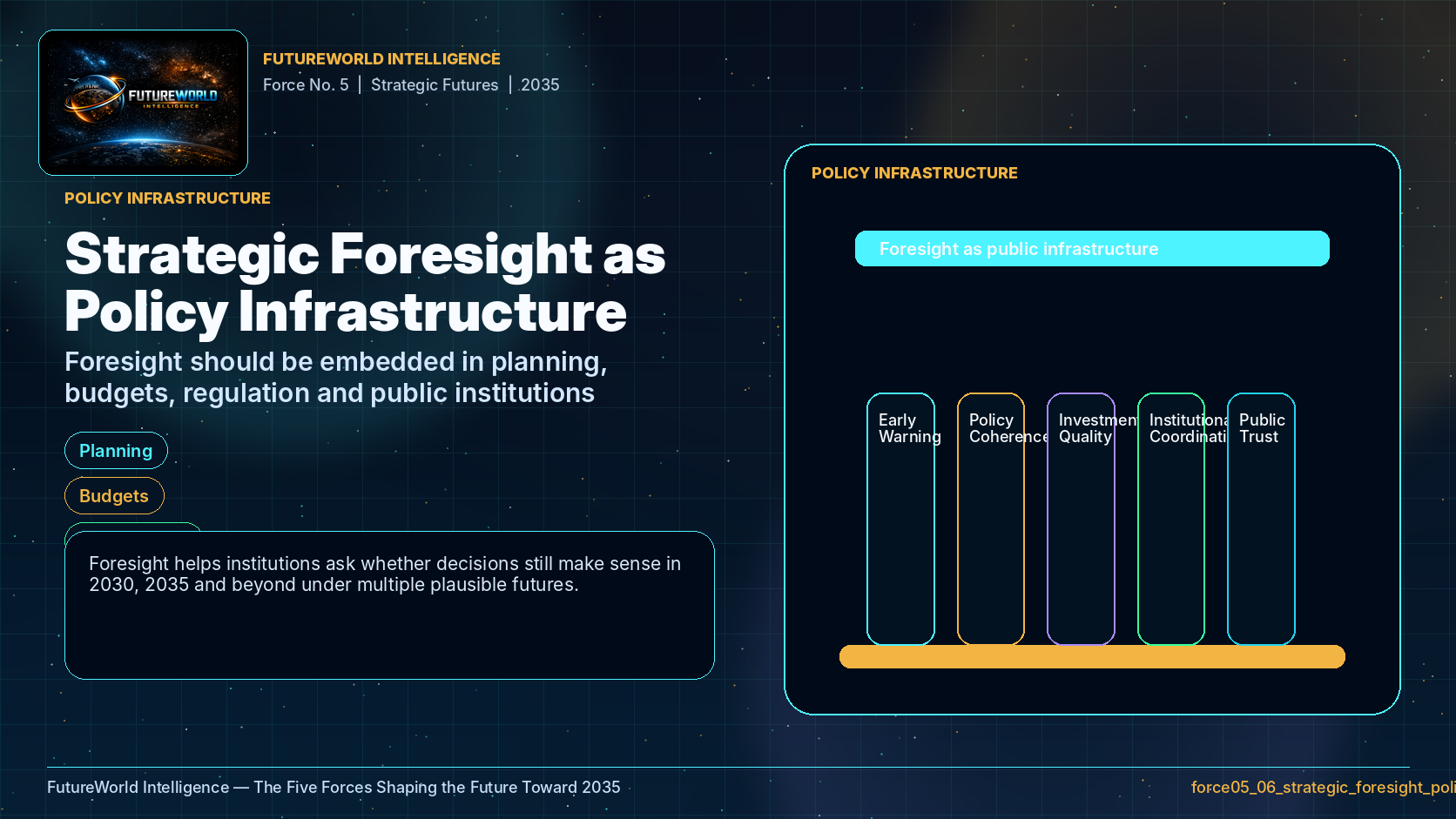
Strategic foresight as policy infrastructure: early warning, policy coherence, investment quality, coordination and trust.
Figure 6. Strategic foresight as policy infrastructure: early warning, policy coherence, investment quality, coordination and trust.

Strategic foresight should be treated as policy infrastructure in the same way that roads, grids, schools, health systems and data systems are treated as public infrastructure.

Policy infrastructure is not only physical. It also includes the systems through which societies think, decide and coordinate.

A country without foresight capacity may still build roads, schools and hospitals. But it may build them in the wrong places, for yesterday’s risks, with outdated assumptions and insufficient resilience.

Strategic foresight helps governments and institutions make better long-term decisions in five ways.

First, it improves early warning by scanning weak signals and emerging risks.

Second, it improves policy coherence by connecting climate, technology, energy, security, education, finance and development planning.

Third, it improves investment quality by testing whether infrastructure remains useful under different future scenarios.

Fourth, it improves institutional coordination by encouraging departments to plan across silos.

Fifth, it improves public trust by showing that institutions are preparing for future risks rather than reacting only after failure.

Strategic foresight should therefore be embedded in national planning commissions, finance ministries, climate authorities, disaster-management agencies, education departments, technology regulators, energy planners, local governments and parliamentary committees.

This does not require every institution to become a foresight laboratory. It requires every major institution to ask future-facing questions before making long-term decisions.

The policy test is simple: will this decision still make sense in 2030, 2035 and beyond under multiple plausible futures?


5. Scenario Planning Toward 2035

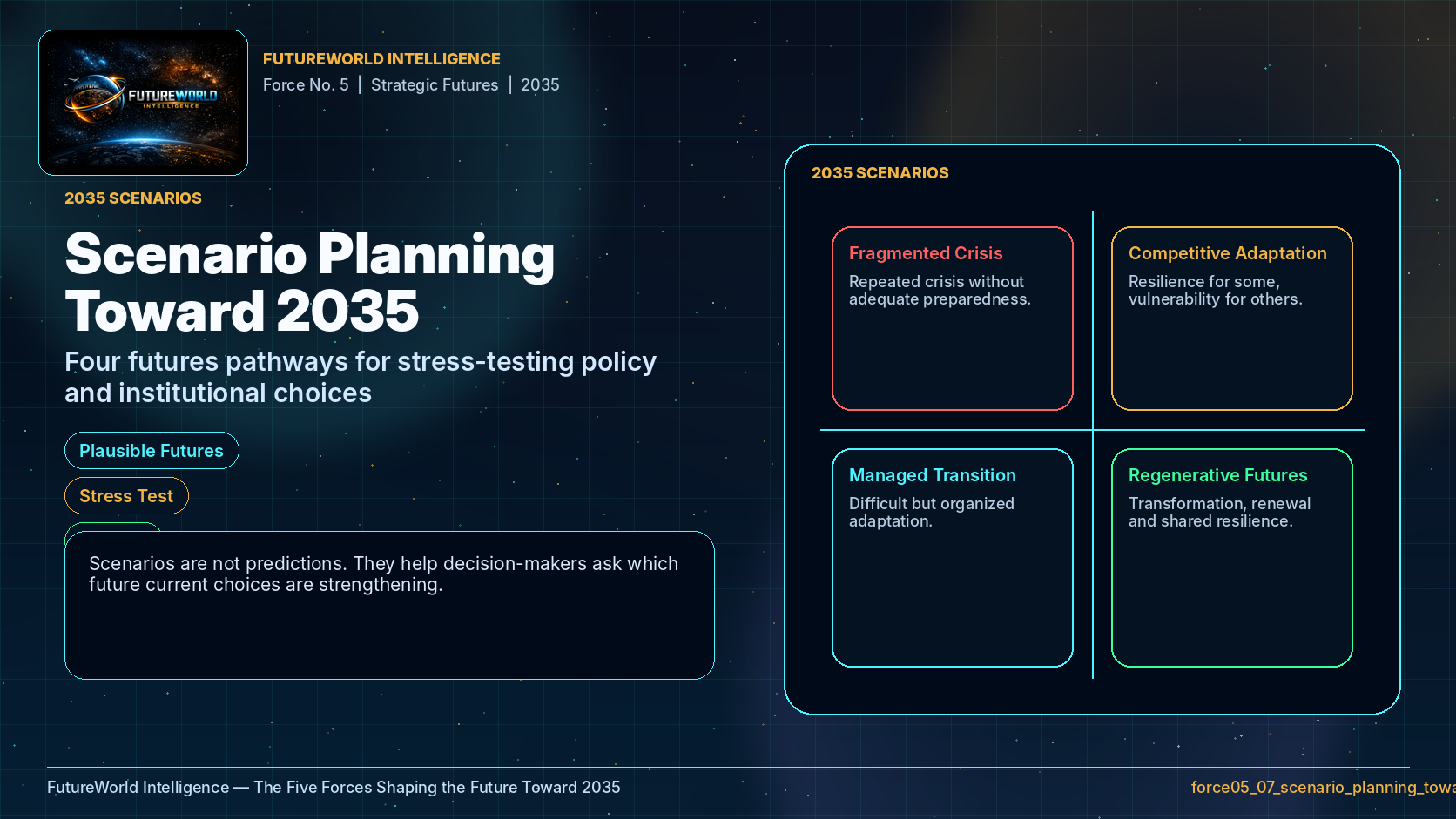
Four 2035 scenarios: fragmented crisis, competitive adaptation, managed transition and regenerative futures.
Figure 7. Four 2035 scenarios: fragmented crisis, competitive adaptation, managed transition and regenerative futures.

Scenario planning is one of the core tools of Strategic Futures.

A scenario is not a prediction. It is a structured story about how the future could unfold based on current drivers, uncertainties and choices. The purpose is not to guess correctly. The purpose is to prepare intelligently.

For the FutureWorld Intelligence Five Forces framework, four broad 2035 scenarios are especially useful.

5.1 Scenario One: Fragmented Crisis

In this scenario, climate shocks intensify, AI adoption becomes uneven and poorly governed, geopolitical rivalry deepens, energy transition remains unequal, and institutions remain reactive. Supply chains become more expensive, trust declines, displacement rises and development becomes more fragile.

This is the scenario of repeated crisis without adequate preparedness.

5.2 Scenario Two: Competitive Adaptation

In this scenario, states recognize major risks but respond primarily through national competition. Countries invest in AI, energy security, defence, local manufacturing and climate adaptation, but cooperation remains limited. Some societies become more resilient, while weaker states fall further behind.

This is the scenario of resilience for some and vulnerability for others.

5.3 Scenario Three: Managed Transition

In this scenario, governments and institutions improve foresight capacity, coordinate investments, modernize grids, regulate AI, diversify supply chains, strengthen disaster preparedness, support vulnerable communities and pursue selective international cooperation.

This is the scenario of difficult but organized adaptation.

5.4 Scenario Four: Regenerative Futures

In this scenario, societies move beyond crisis management toward long-term renewal. Climate resilience, AI governance, energy transition, human development, ecological restoration, education reform and institutional trust become integrated. Local communities, governments, universities, civil society and the private sector participate in shaping futures.

This is the scenario of transformation, not merely survival.

The purpose of these scenarios is not to claim that one will happen. The purpose is to help decision-makers ask: which pathway are current decisions strengthening?


6. Anticipatory Governance and Early-Warning Systems

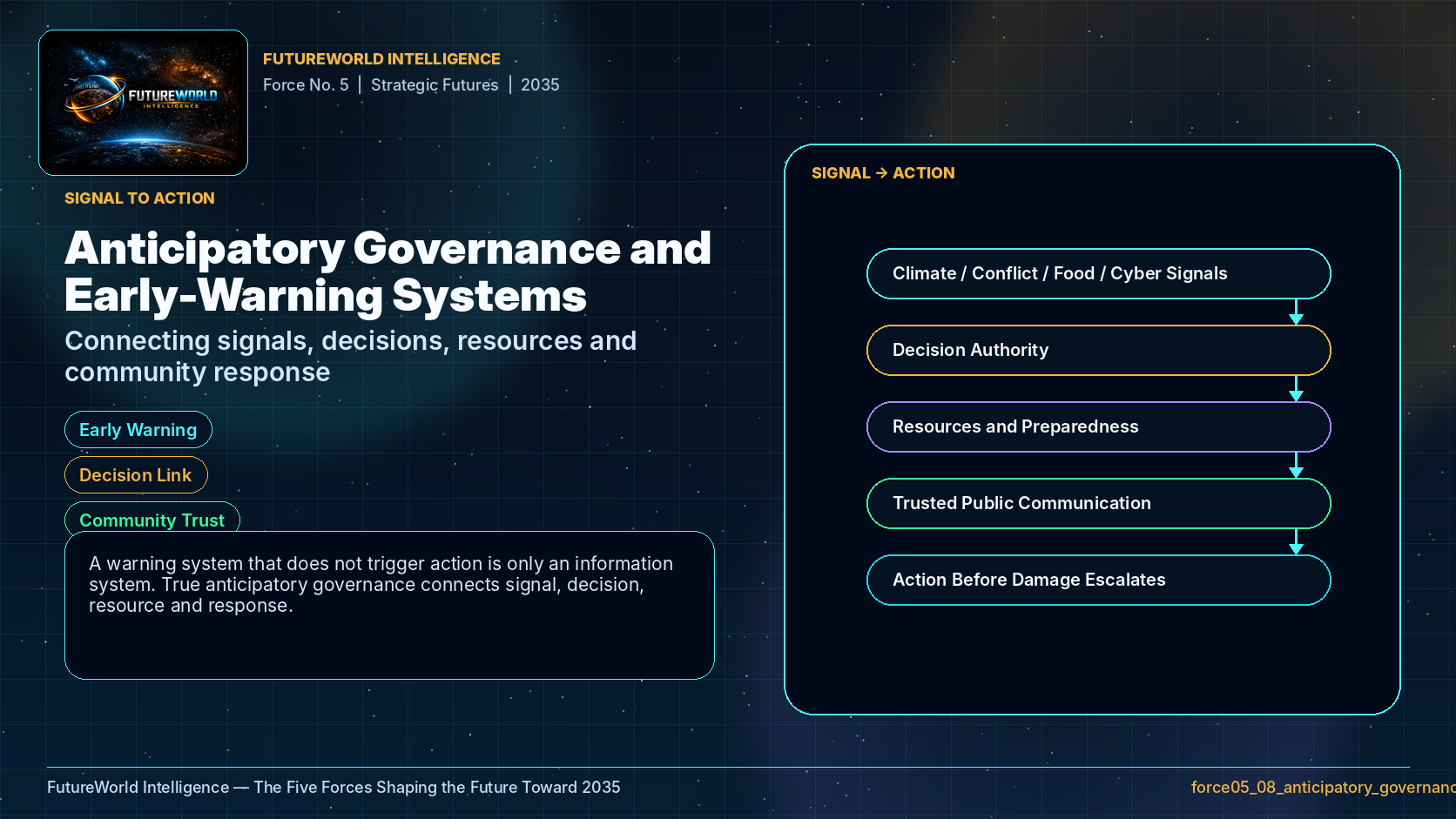
Anticipatory governance connects signal, decision, resource and response before risks escalate.
Figure 8. Anticipatory governance connects signal, decision, resource and response before risks escalate.

Strategic Futures becomes practical when it is translated into anticipatory governance.

Anticipatory governance is the capacity of institutions to identify emerging risks, prepare policy options, test assumptions, act before damage escalates and adjust as conditions change.

This requires early-warning systems, but not only in the technical sense.

Early warning should include climate early warning, conflict early warning, food-security monitoring, disease surveillance, cyber-risk monitoring, financial-stress tracking, energy-security alerts, misinformation detection, social-cohesion indicators and infrastructure-vulnerability mapping.

However, warning is not enough. Many disasters happen not because there was no warning, but because warnings were ignored, fragmented, politicized, underfunded or poorly communicated.

Effective anticipatory governance requires three links.

First, signals must reach decision-makers.

Second, decision-makers must have authority and resources to act.

Third, communities must trust and understand the response.

A warning system that does not trigger action is only an information system. A true anticipatory system connects signal, decision, resource and response.

By 2035, governments that build anticipatory systems will be better able to manage climate hazards, technological disruption, geopolitical shocks, energy stress and social instability.


7. Resilience, Adaptation and Institutional Preparedness

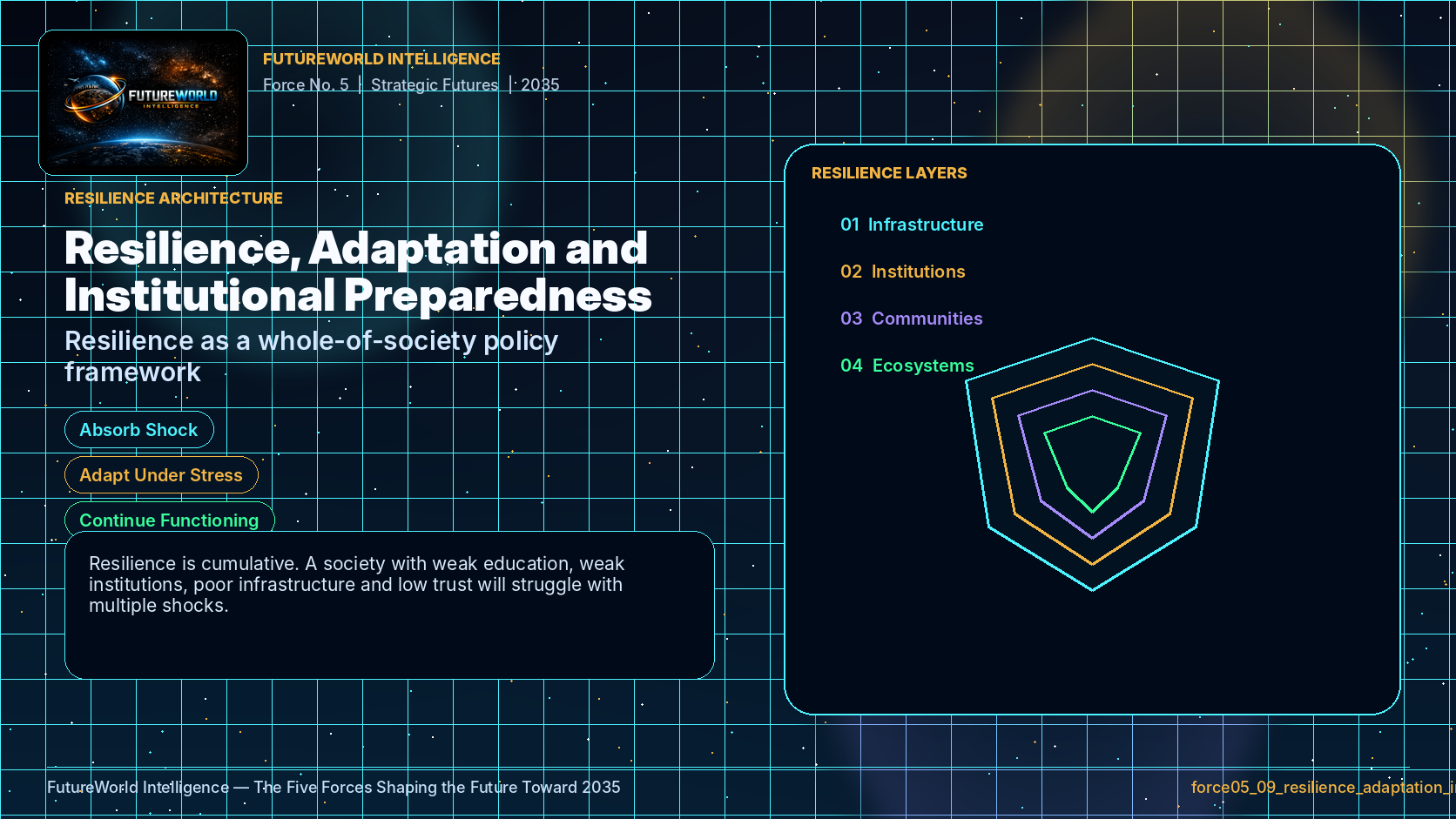
Resilience architecture across infrastructure, institutions, communities, ecosystems, supply chains and public finance.
Figure 9. Resilience architecture across infrastructure, institutions, communities, ecosystems, supply chains and public finance.

Resilience is the ability of a system to absorb shock, adapt under stress and continue functioning without collapse.

Strategic Futures turns resilience from a slogan into a policy framework.

A resilient society requires resilient infrastructure, resilient institutions, resilient communities, resilient ecosystems, resilient supply chains, resilient digital systems and resilient public finances.

This means resilience cannot be left to disaster-management agencies alone. It must be part of national development planning.

Climate resilience requires watershed restoration, flood management, heat planning, drought preparedness, forest protection, ecosystem restoration, climate-resilient agriculture and urban adaptation.

AI resilience requires digital literacy, data governance, institutional safeguards, cybersecurity, accountability mechanisms, public-sector capacity and human oversight.

Geopolitical resilience requires diversified trade, diplomatic flexibility, corridor security, food security, energy security, critical-infrastructure protection and strategic autonomy.

Energy resilience requires reliable grids, storage, distributed generation, affordability, clean cooking, demand management, efficiency and investment in infrastructure.

Human resilience requires education, health, skills, social protection, trust, community organization and participation.

The most important lesson is that resilience is cumulative. A society with weak education, weak institutions, poor infrastructure and low trust will struggle to respond to multiple shocks at the same time.

Strategic Futures therefore requires investment not only in technology, but in institutions and people.


8. Human Development and Social Readiness

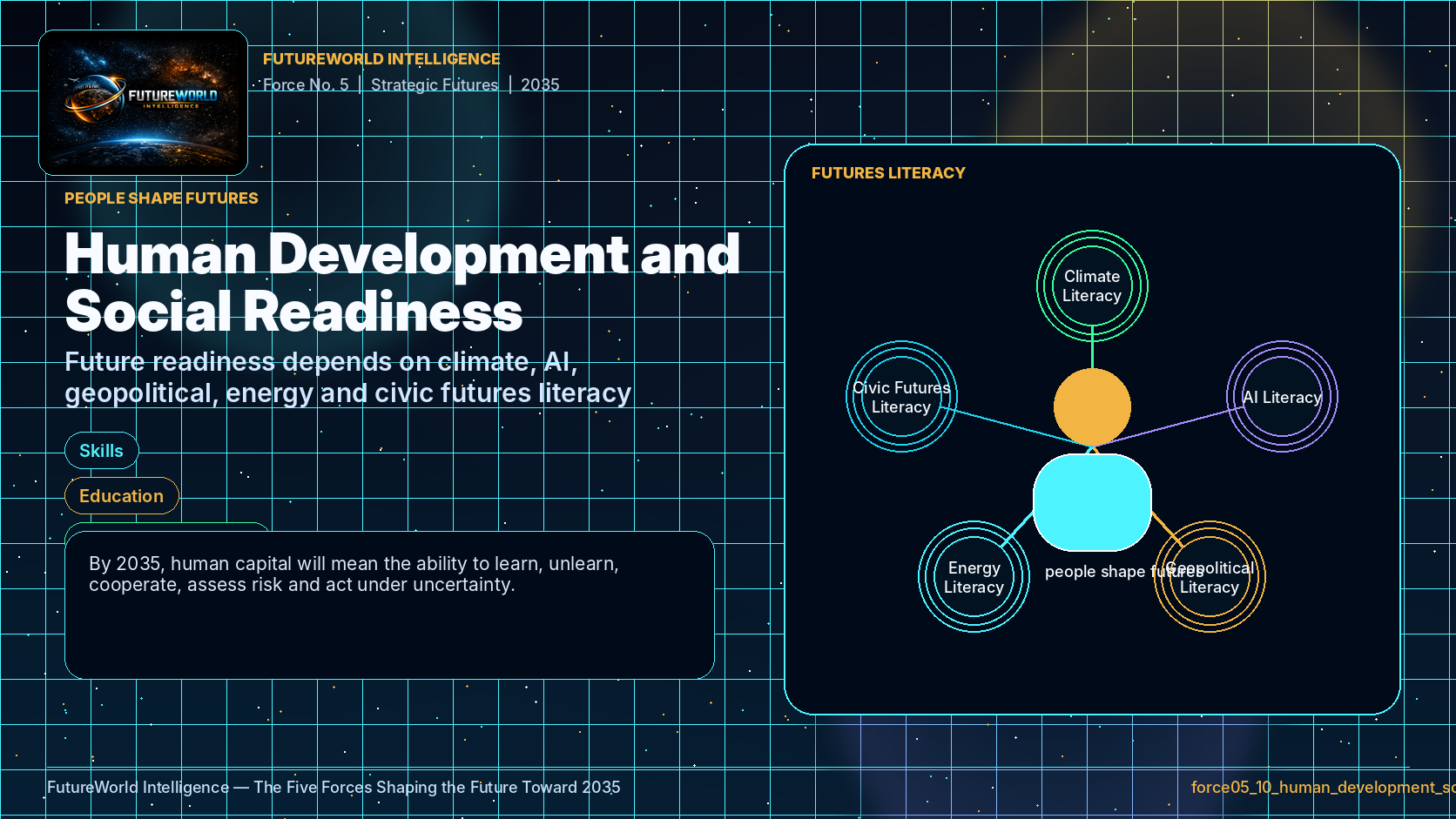
Future readiness requires climate literacy, AI literacy, geopolitical literacy, energy literacy and civic futures literacy.
Figure 10. Future readiness requires climate literacy, AI literacy, geopolitical literacy, energy literacy and civic futures literacy.

The future will not be shaped by systems alone. It will be shaped by people’s capacity to understand and navigate those systems.

Human development is central to Strategic Futures because citizens are not passive recipients of change. They are workers, students, voters, farmers, entrepreneurs, public servants, parents, community leaders and innovators.

A society cannot become future-ready if its people are excluded from future literacy.

Future readiness requires five human capabilities.

First is climate literacy: understanding climate risks, adaptation, mitigation, local ecosystems and resilience.

Second is AI literacy: understanding how AI works, where it helps, where it fails, and how to use it responsibly.

Third is geopolitical literacy: understanding global power, trade, security, regional dynamics, supply chains and national interest.

Fourth is energy literacy: understanding electricity, grids, renewables, efficiency, affordability, access and energy security.

Fifth is civic futures literacy: understanding uncertainty, scenarios, public choices, institutional responsibility and community action.

This is why education must become part of futures policy.

Schools, universities, training institutes, civil-service academies, media platforms and community organizations should help citizens understand the forces shaping their lives. Future-ready societies will not only produce technical experts. They will produce informed citizens capable of making better collective choices.

By 2035, human capital will not only mean degrees and labour skills. It will also mean adaptive intelligence: the ability to learn, unlearn, cooperate, assess risk and act under uncertainty.


9. National and Regional Futures Capacity

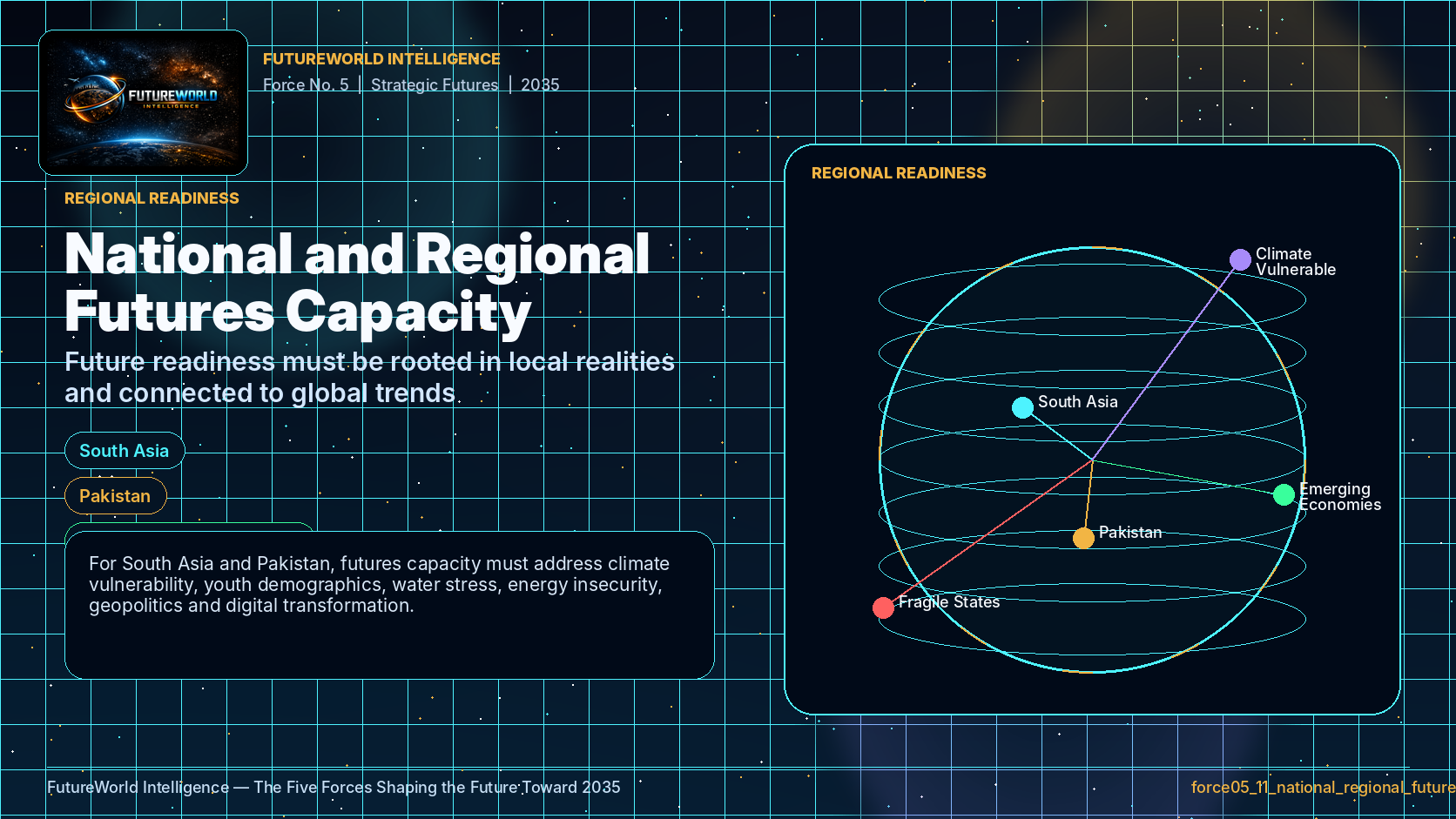
Futures capacity must be adapted to national and regional realities, including South Asia and Pakistan.
Figure 11. Futures capacity must be adapted to national and regional realities, including South Asia and Pakistan.

Strategic Futures will look different in different regions.

Advanced economies may focus on AI regulation, aging populations, energy-system modernization, industrial competitiveness, cybersecurity, defence burdens, immigration, climate adaptation and democratic resilience.

Emerging economies may focus on infrastructure, job creation, urbanization, energy access, digital development, industrial policy, education, supply-chain opportunities and climate vulnerability.

Fragile states may focus on conflict prevention, food security, displacement, water stress, governance legitimacy, humanitarian response, local resilience and basic service delivery.

Small island and climate-vulnerable states may focus on sea-level rise, disaster finance, relocation planning, insurance, loss and damage, ocean governance and adaptation funding.

For South Asia and Pakistan, Strategic Futures is especially important because multiple forces converge: climate vulnerability, youth demographics, water stress, energy insecurity, geopolitical pressure, digital transformation, fiscal constraints and development needs.

Pakistan’s future-readiness agenda should include climate-resilient watersheds, energy-sector modernization, AI literacy, public-sector digital capacity, skill development, regional trade thinking, disaster preparedness, food security, urban planning, institutional reform and community-based resilience.

The goal is not to copy the foresight model of another country. The goal is to build a context-specific futures capacity rooted in local realities but connected to global trends.

A country becomes future-ready when it understands both the world and itself.


10. FutureWorld Intelligence 2035 Scenario Framework

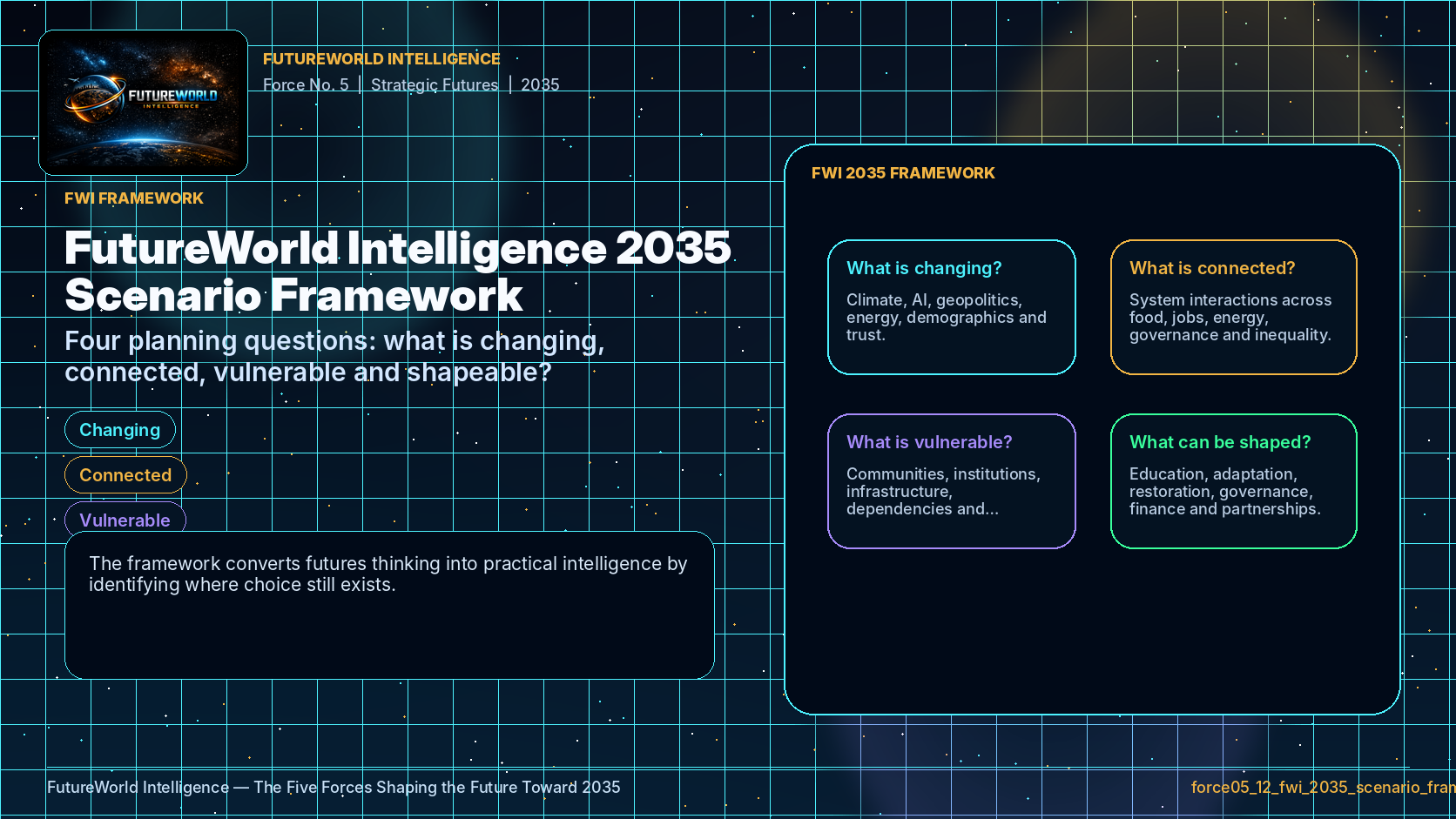
FutureWorld Intelligence 2035 framework: what is changing, connected, vulnerable and shapeable.
Figure 12. FutureWorld Intelligence 2035 framework: what is changing, connected, vulnerable and shapeable.

FutureWorld Intelligence can organize its Strategic Futures framework around four planning questions.

10.1 What Is Changing?

This includes the major forces: climate, AI, geopolitics, energy, demographics, finance, institutions, ecosystems, cities, skills, media and public trust.

10.2 What Is Connected?

This identifies system interactions: climate and food, AI and jobs, geopolitics and energy, energy and industry, displacement and governance, education and resilience, technology and inequality.

10.3 What Is Vulnerable?

This maps exposed communities, weak institutions, fragile infrastructure, risky dependencies, unprepared sectors, climate hotspots, digital vulnerabilities and social fault lines.

10.4 What Can Be Shaped?

This identifies areas where action is possible: education, adaptation, restoration, energy planning, institutional reform, digital literacy, local governance, finance, community mobilization, public awareness and strategic partnerships.

This framework converts futures thinking into practical intelligence.

It does not ask people to fear the future. It asks them to understand where choice still exists.


11. FutureWorld Intelligence Assessment

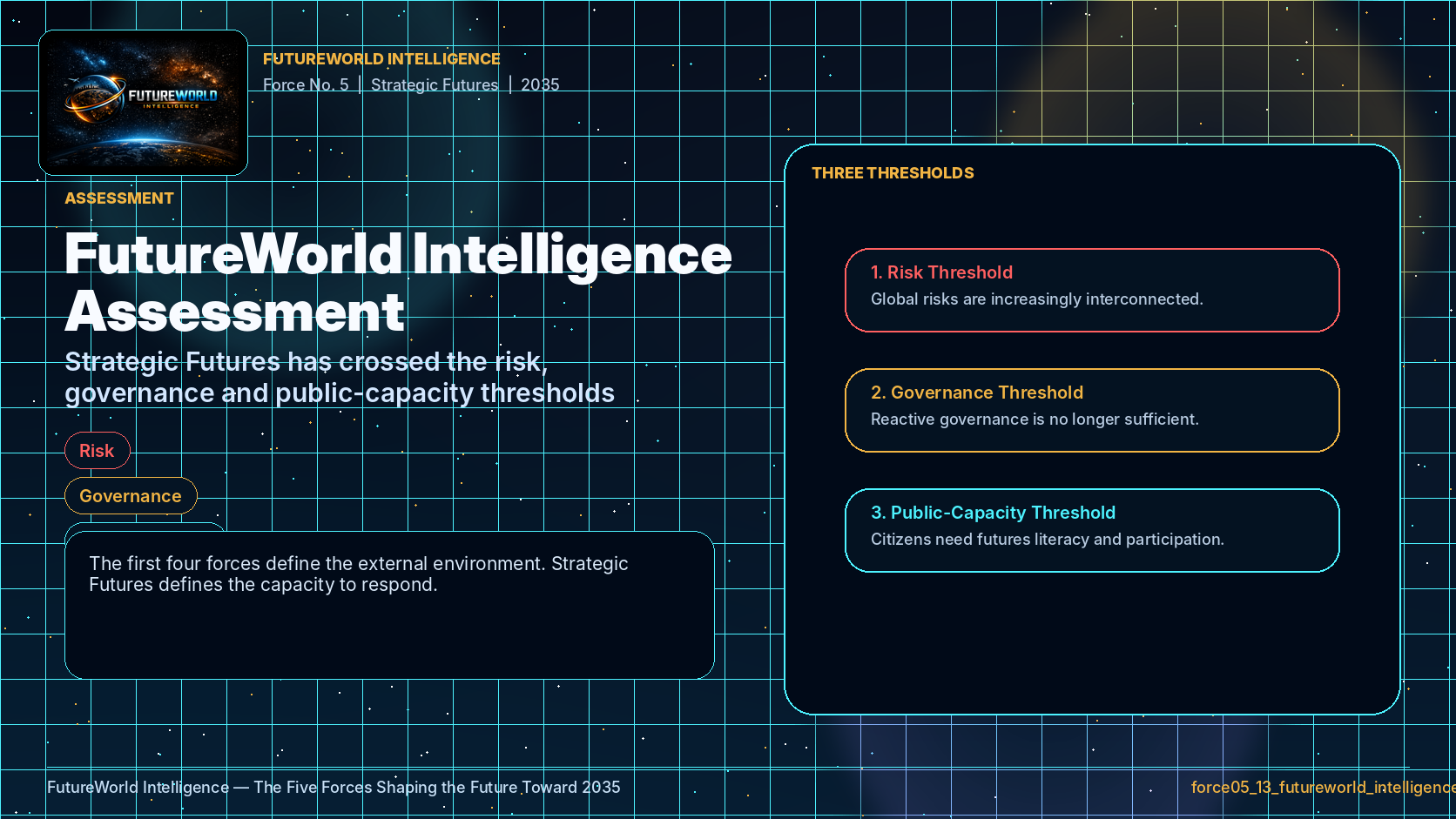
Strategic Futures crosses the risk, governance and public-capacity thresholds.
Figure 13. Strategic Futures crosses the risk, governance and public-capacity thresholds.

Strategic Futures is one of the five forces shaping the future because it has already crossed three thresholds.

First, it has crossed the risk threshold. Global risks are increasingly interconnected. Climate hazards, AI disruption, geopolitical fragmentation, energy transition, displacement, food insecurity, cyber threats and institutional stress cannot be managed in isolation.

Second, it has crossed the governance threshold. Traditional reactive governance is no longer sufficient. States and institutions need anticipatory planning, adaptive regulation, early warning, scenario analysis and cross-sector coordination.

Third, it has crossed the public-capacity threshold. Citizens need future literacy. Communities, students, workers and local institutions must understand the forces shaping their lives if they are to participate in resilience and transformation.

This makes Strategic Futures a system-shaping force.

The first four forces define the external environment. Strategic Futures defines the capacity to respond.

By 2035, the most successful societies will not be those that avoid all shocks. No society can do that. They will be those that prepare early, adapt quickly, protect people, maintain trust and learn continuously.

Strategic Futures is the difference between being surprised by disruption and being ready for transformation.


12. Limitations, Open Questions and Responsible Reading

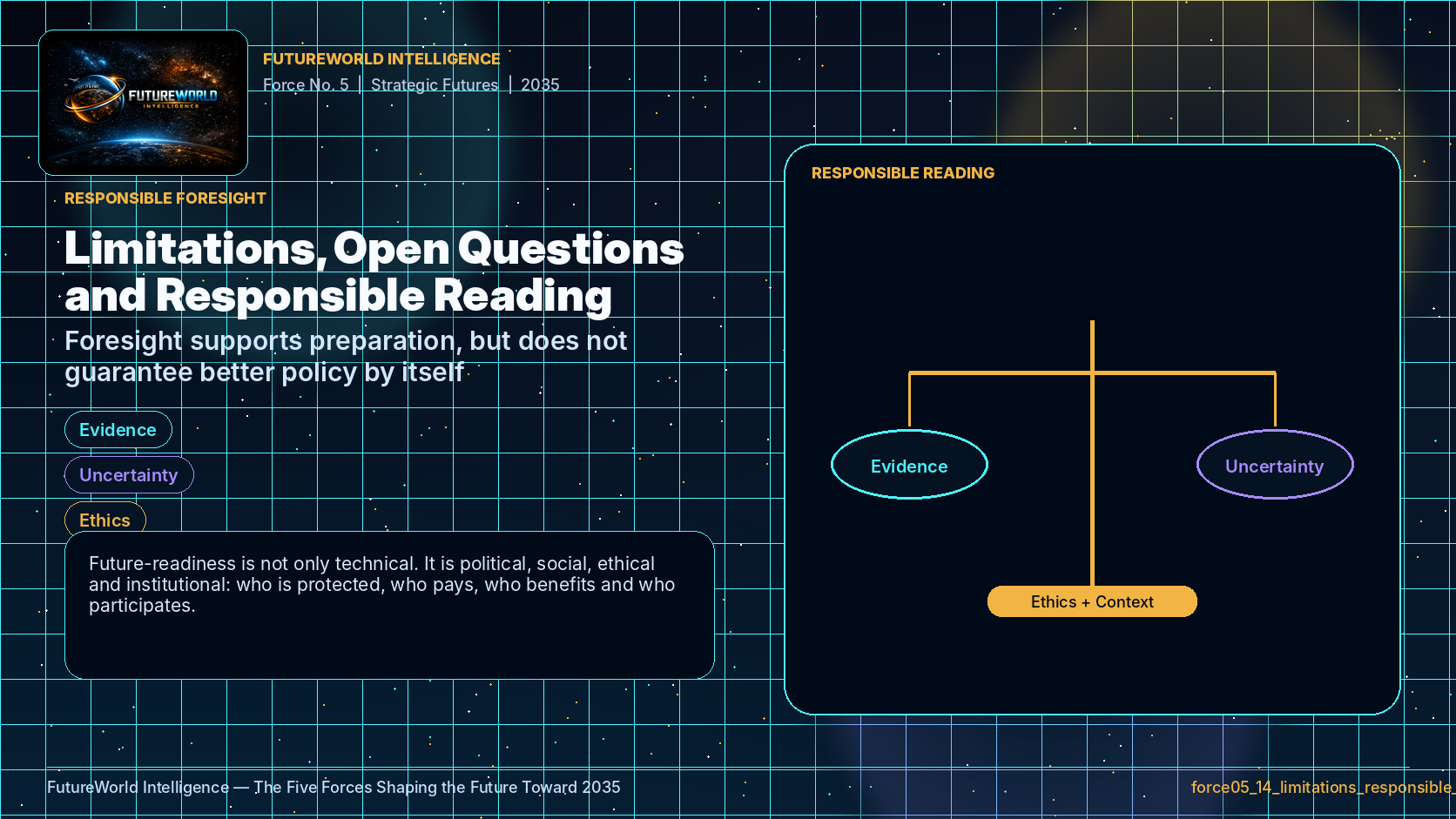
Responsible reading distinguishes evidence, contested claims, projections and values.
Figure 14. Responsible reading distinguishes evidence, contested claims, projections and values.

Several claims in this report are well-evidenced. Global risks are increasingly interconnected. Military expenditure, forced displacement, climate exposure, energy-system transformation and AI governance challenges show that the world is entering a period of structural uncertainty. Foresight, scenario planning, early warning and resilience planning are recognized tools for improving preparedness.

Several areas remain contested or context-dependent. Strategic foresight does not guarantee better policy if institutions lack resources, authority or trust. Scenario planning can be misused if treated as prediction. Early-warning systems can fail if warnings are ignored. Resilience can become unequal if wealthy groups adapt while vulnerable communities remain exposed. Anticipatory governance can become technocratic if citizens are excluded.

This report also recognizes that future-readiness is not only a technical issue. It is political, social, ethical and institutional. Decisions about the future involve values: who is protected, who pays, who benefits, who participates and which risks are considered acceptable.

The 2035 pathways in this report are projections and planning tools, not certainty. Their purpose is to support policy thinking, education, public awareness and strategic preparation.


Final Report Statement

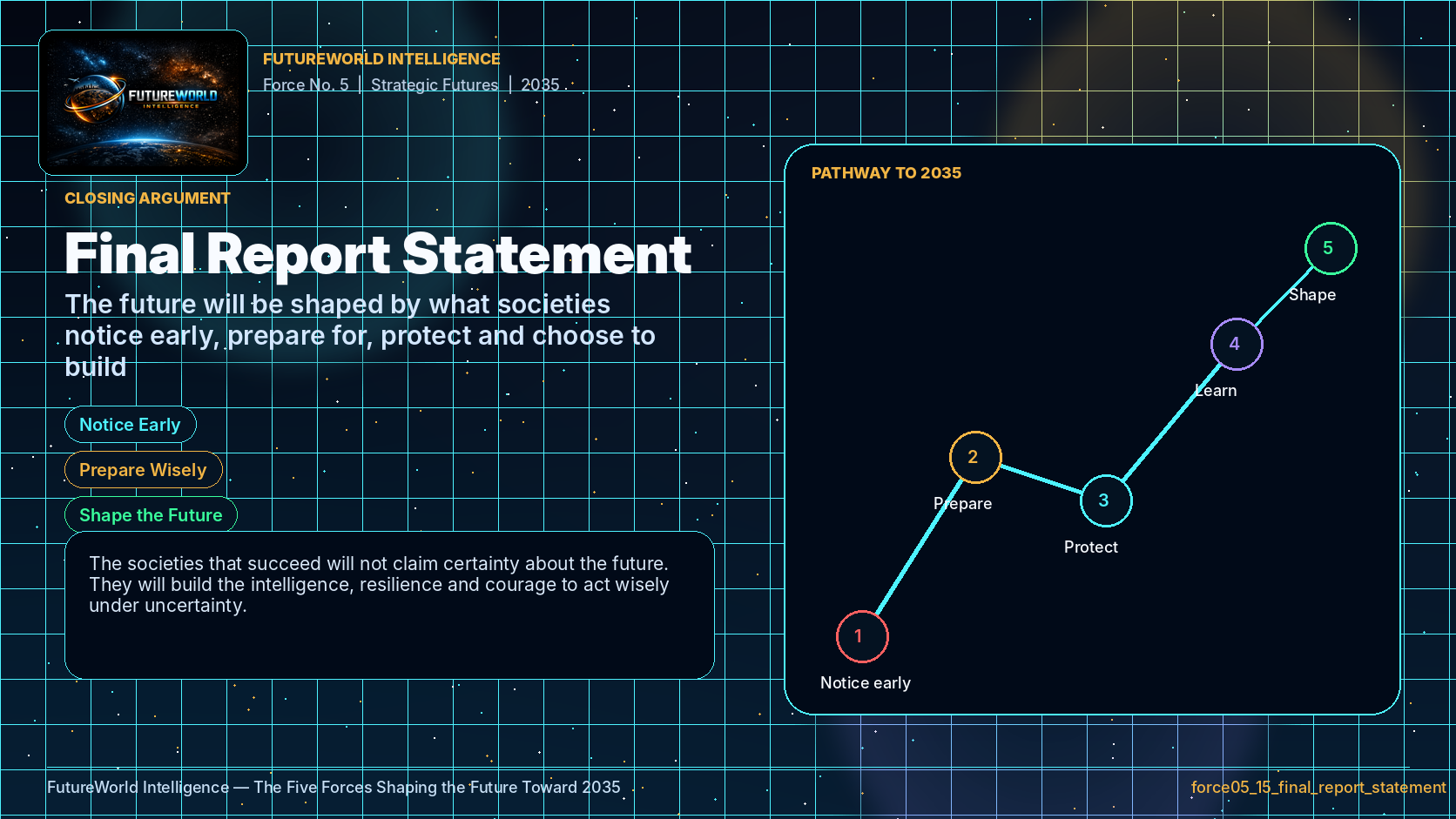
The future will be shaped by what societies notice, ignore, prepare for, teach, protect and build.
Figure 15. The future will be shaped by what societies notice, ignore, prepare for, teach, protect and build.

Strategic Futures is shaping the world because the future is becoming too complex for reactive governance alone.

Climate change, artificial intelligence, geopolitics and energy transition are already reorganizing the physical, cognitive, power and infrastructure foundations of human society. But these forces do not determine outcomes by themselves. Outcomes depend on preparedness, governance, resilience, institutional capacity, public trust and human development.

The future will be shaped by what societies notice early, what they ignore, what they prepare for, what they invest in, what they teach, what they protect and what they choose to build.

By 2035, strategic futures capacity may become one of the most important indicators of national preparedness and institutional maturity.

The societies that succeed will not be those that claim certainty about the future. They will be those that build the intelligence, resilience and courage to act wisely under uncertainty.


Source Base

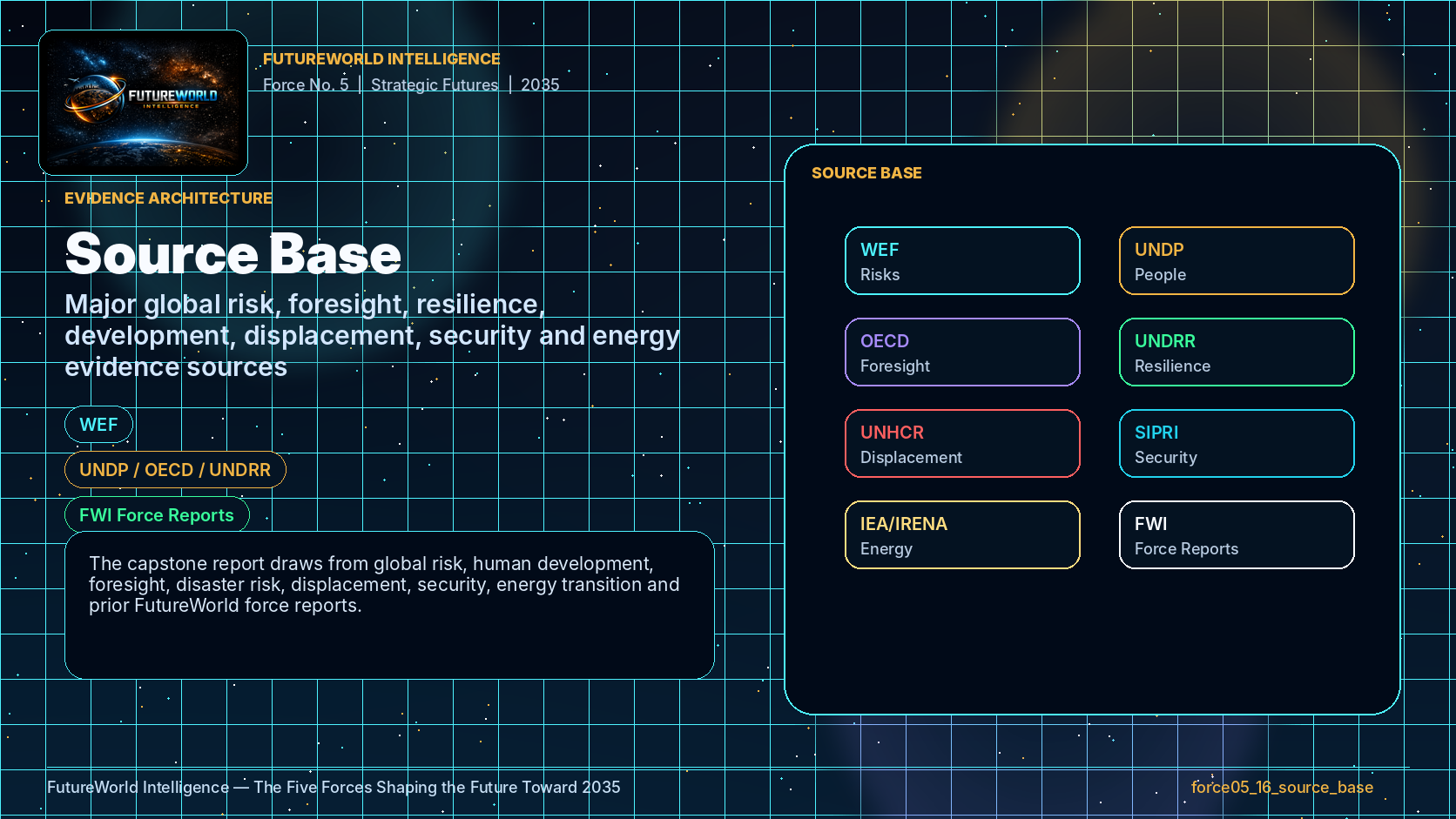
Source base connecting global risk, human development, foresight, disaster risk, displacement, security and energy-transition evidence.
Figure 16. Source base connecting global risk, human development, foresight, disaster risk, displacement, security and energy-transition evidence.

World Economic Forum
Global Risks Report 2026 and Global Risks Perception Survey, including analysis of short-term and long-term risk horizons, economic confrontation, environmental risks, geopolitical stress and AI governance.

United Nations Development Programme
Human Development Reports, including work on uncertainty, human development, polarization, AI and the importance of people-centred development.

Organisation for Economic Co-operation and Development
Strategic foresight, anticipatory governance, public-sector innovation and policy capacity frameworks.

United Nations Office for Disaster Risk Reduction
Global Assessment Report on Disaster Risk Reduction and systemic-risk frameworks, including resilience, prevention and preparedness.

United Nations High Commissioner for Refugees
Global Trends 2024 reporting on forced displacement, conflict, persecution, returns, long-term displacement and humanitarian pressure.

Stockholm International Peace Research Institute
SIPRI Military Expenditure Database and analysis of defence spending as an indicator of geopolitical stress.

International Energy Agency and International Renewable Energy Agency
IEA World Energy Investment 2025 and IRENA publications on energy investment, renewable capacity, electricity systems, critical minerals, energy security and infrastructure transformation.

FutureWorld Intelligence Force Reports
Force No. 1: Climate Change as a Global System-Shaping Force.
Force No. 2: Artificial Intelligence as Cognitive Infrastructure.
Force No. 3: Geopolitics as a Fragmented Power System.
Force No. 4: Energy Transition as an Infrastructure Shift.