The Gulf Region — Energy, Maritime Chokepoints and Strategic Power
A FutureWorld Intelligence report applying the 9-pillar geopolitics framework to the Gulf’s geography, oil and LNG flows, maritime routes, sovereign wealth, alliances, law and future scenarios.
Seaborne trade About 80% of world goods trade by volume moves by sea
Core message The Gulf is an energy-finance-logistics-security system.
FWI publication information
Identity, scope and status
Retrospective validation pending
Publication family
Research and Strategic Analysis
Publication type
FWI Strategic Intelligence Report
Domain
Geopolitics Intelligence
Series and number
Geopolitics Intelligence #006
Institutional author
FutureWorld Intelligence
Publication year
2026
Current web edition
1.0
Metadata updated
15 July 2026
Purpose
Assess a strategic geopolitical system, region, capability or risk
Intended audience
Policy readers, researchers, analysts and informed public
Method and evidence basis
Desk-based G-D-T-L-S strategic analysis
Evidence cut-off
The exact historical evidence cut-off was not recorded when the original web publication was prepared. Source currency will be confirmed during retrospective validation.
Limitations and disclosures
Classification and metadata do not independently validate substantive claims. Citation, factual, originality, AI-use, rights and conflict-of-interest checks remain part of the pending retrospective validation.
Validation note: This classification does not itself validate the publication. Retrospective factual, citation, originality, disclosure and readiness checks must be completed and human-approved before the status can change to “Validated — human approved.”
The Gulf should be understood as an energy-finance-logistics-security system. Its importance comes from the interaction between geography, oil and gas, ports, sovereign wealth, alliances, maritime law, military presence and future climate stress.
The Gulf region is one of the clearest examples of how geography becomes strategic power. A narrow waterway, the Strait of Hormuz, connects the Persian Gulf to the Gulf of Oman and the Arabian Sea. Around it sit some of the world’s most important hydrocarbon exporters, including Saudi Arabia, the United Arab Emirates, Qatar, Kuwait and Iraq, while Iran controls the northern side of the chokepoint and Oman sits on the southern side. The region also connects to the Red Sea, Bab el-Mandeb, Suez Canal and Mediterranean route, making Gulf energy flows part of a wider chain of connected maritime chokepoints.
The 2024–2026 data reinforce the region’s continued relevance. The U.S. Energy Information Administration estimates that 20.7 million barrels per day of crude oil and petroleum liquids moved through the Strait of Hormuz in 2024, while about one-fifth of global LNG trade also moved through Hormuz, mainly from Qatar. EIA’s 2026 chokepoint analysis also shows how Red Sea insecurity reduced flows through Bab el-Mandeb and the Suez/SUMED route in 2024, while rerouting around the Cape of Good Hope increased. These figures make the Gulf not only a production center but a global risk transmission point: disruption in one strait can affect energy prices, insurance, shipping time, logistics planning and strategic calculations far beyond the Middle East.
The Gulf is also changing. Gulf states are no longer only exporters of crude oil. They are investing in LNG expansion, petrochemicals, refining, ports, aviation, renewable energy, data infrastructure, tourism, financial services, logistics corridors and industrial diversification. Sovereign wealth funds convert hydrocarbon revenue into long-term capital power. Ports such as Jebel Ali, Fujairah, Ras Laffan, Ras Tanura, Jubail and Duqm show how energy geography is being linked with logistics and industrial strategy. The region therefore sits at the intersection of older resource power and newer systems capacity.
Security remains central. The Gulf is shaped by U.S. security partnerships, GCC coordination, OPEC and OPEC+ energy diplomacy, Red Sea security, naval presence in the Gulf and Arabian Sea, and relationships with China, India, Europe and other Asian consumers. Gulf states are pursuing multipolar balancing: maintaining security ties with the United States, expanding trade and energy relationships with Asia, deepening investment links with Europe and Asia, and using diplomacy to reduce exposure to a single bloc. This balancing is not a contradiction; it is the normal strategy of medium and resource-rich states in a multipolar environment.
Why the Gulf matters
Geographic system: a narrow sea with global reach
The Gulf’s geography creates both opportunity and vulnerability. It is a semi-enclosed maritime space bordered by major energy producers and linked to the wider Indian Ocean through the Strait of Hormuz. This makes it an export corridor, a security theater and a diplomatic pressure point at the same time. The Persian Gulf, Gulf of Oman, Arabian Sea, Red Sea, Bab el-Mandeb, Suez Canal and Mediterranean route form a chain. Energy moving from Gulf terminals to Europe may pass through Hormuz, Bab el-Mandeb and Suez/SUMED. Energy moving toward Asia passes through Hormuz and then across the Arabian Sea and Indian Ocean. In both directions, Gulf energy is not only a commodity; it is cargo moving through vulnerable spaces.
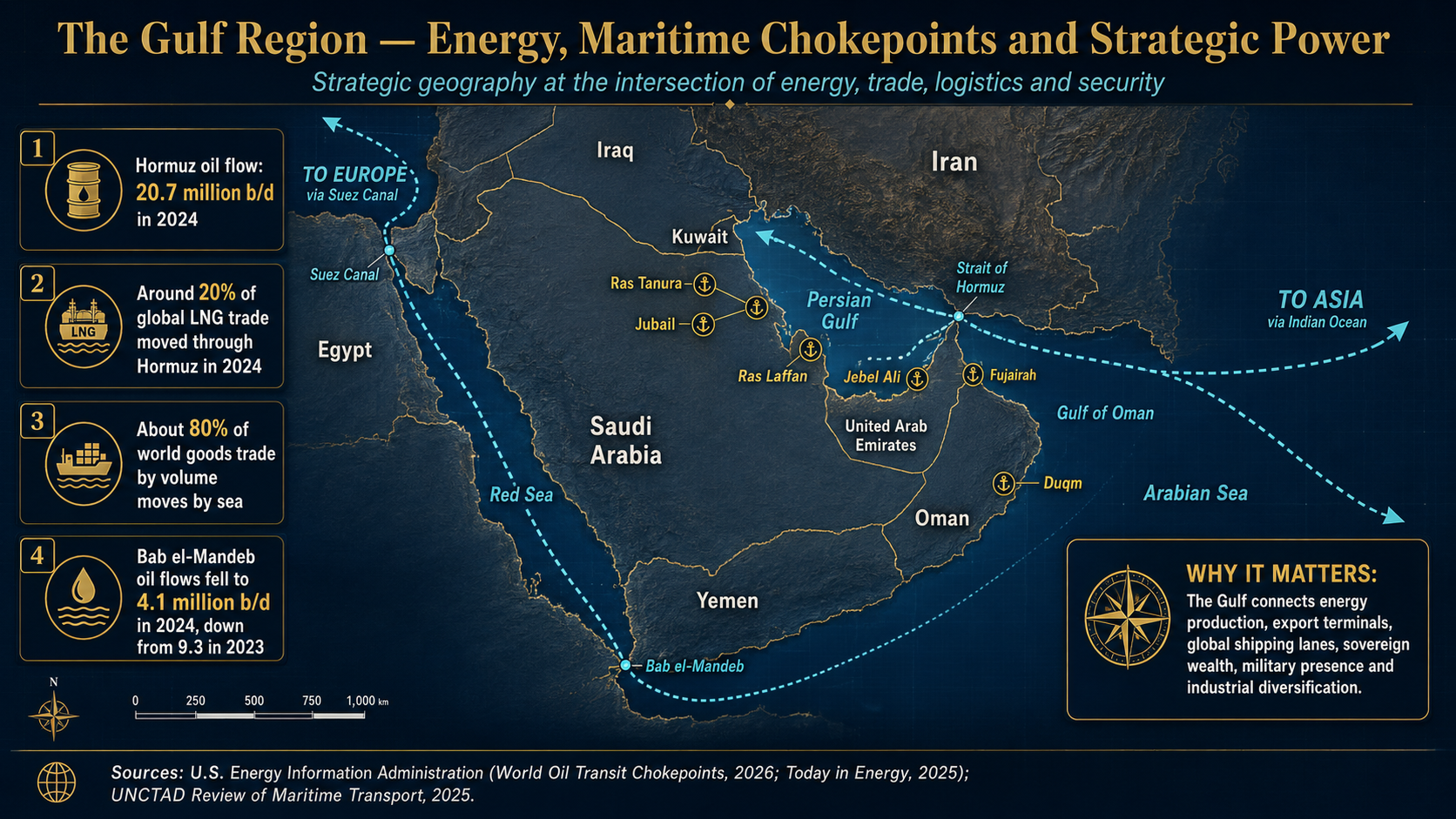
Visual 1. Gulf strategic map. This map belongs in the geography section because it shows the region’s core location, water bodies, major energy hubs, Hormuz, Bab el-Mandeb, Suez and direction of routes toward Europe and Asia.
Geography also explains why alternative routes matter. Saudi Arabia’s East-West pipeline links eastern production areas to Red Sea export terminals, reducing total dependence on Hormuz for some volumes. The UAE’s Fujairah export facilities provide access to the Gulf of Oman outside the Strait of Hormuz. Oman’s Duqm port sits on the Arabian Sea and is important because it is not inside the Gulf. These alternatives do not remove Gulf vulnerability, but they create partial redundancy, which is central to resilience planning.
The Gulf’s location also produces diplomatic significance. It is close to South Asia, East Africa, the Red Sea, the eastern Mediterranean, Central Asia and the wider Indian Ocean. This means Gulf states can connect multiple regions through energy, finance, aviation, ports and investment. They can supply Asian markets, invest in African and Asian infrastructure, mediate in regional disputes, host military facilities, and support global energy stability. In FutureWorld terms, the Gulf is a hinge region: a place where several systems meet and where local events can become global consequences.
FutureWorld definition: The Gulf is a strategic hinge region where energy production, maritime chokepoints, financial capital, sovereign wealth, logistics infrastructure and security partnerships convert local geography into global influence.
Energy and resource power
Oil, LNG, petrochemicals and sovereign wealth
Energy is the historical foundation of Gulf power, but the meaning of energy power is expanding. Crude oil remains central to state revenue, global supply and price stability. LNG has increased the Gulf’s importance in Asian energy security, especially through Qatar’s role as a leading LNG exporter. Petrochemicals, refining and industrial zones convert energy resources into higher-value production. Sovereign wealth funds convert oil and gas revenue into global investment power. Ports and logistics convert location into connectivity.
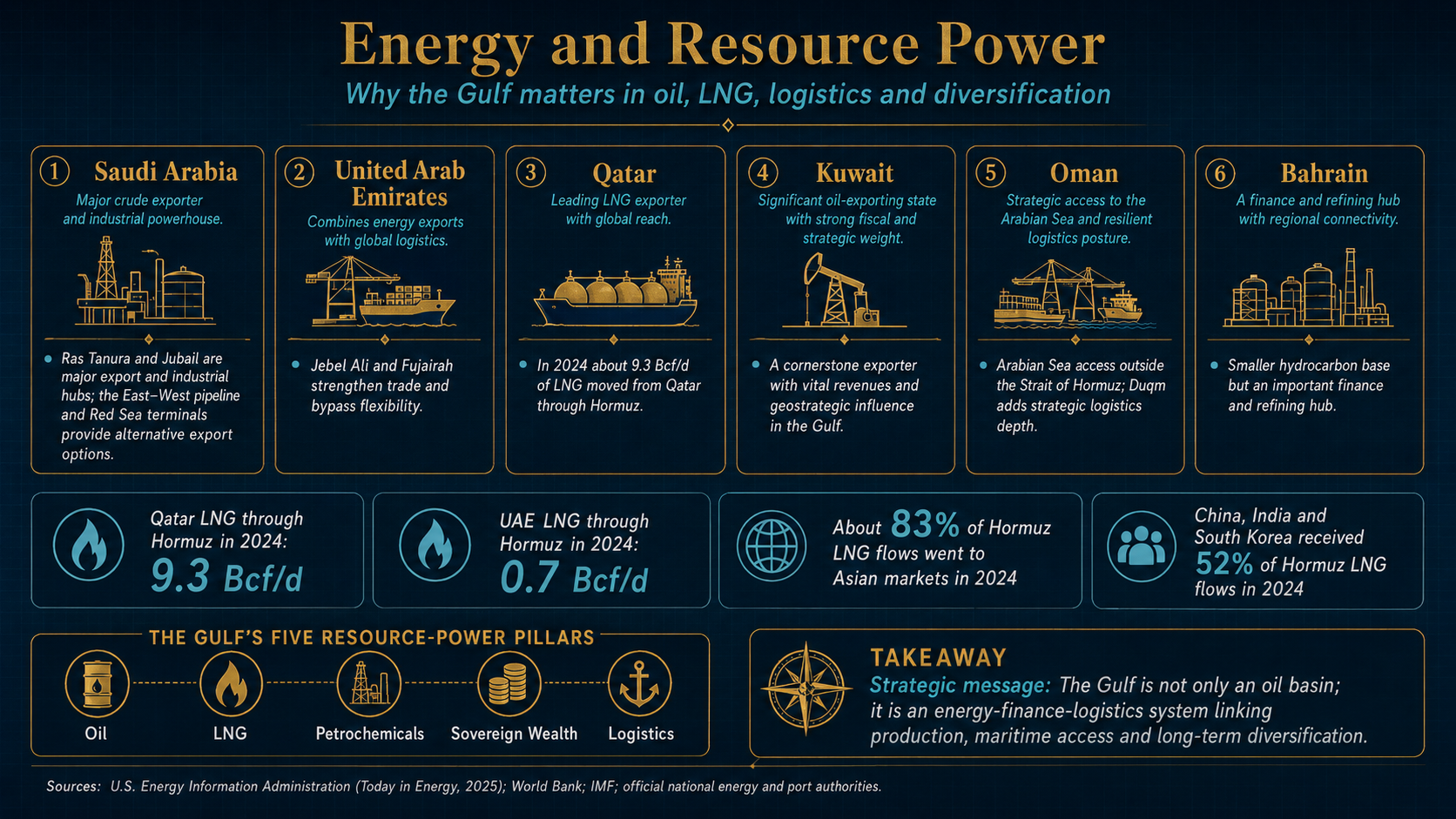
Visual 2. Energy and resource power. This chart belongs in the energy section because it compares Gulf state roles, LNG flow figures, resource pillars and diversification logic.
The EIA’s 2025 LNG analysis is especially important for understanding Qatar and the Strait of Hormuz. It reported that about 20% of global LNG trade moved through Hormuz in 2024, primarily from Qatar. Qatar exported about 9.3 Bcf/d of LNG through Hormuz in 2024, while the UAE exported about 0.7 Bcf/d. The same EIA analysis estimated that 83% of LNG moving through Hormuz went to Asian markets, with China, India and South Korea receiving 52% of Hormuz LNG flows in 2024. These figures show that Gulf LNG is not only a regional commodity; it is embedded in the industrial and power-generation systems of Asia.
Saudi Arabia remains central because of its crude export role, spare capacity relevance, OPEC/OPEC+ diplomacy and industrial diversification strategy. The UAE is important because it combines energy exports with ports, aviation, logistics, finance and global trade. Qatar is crucial because LNG links the Gulf directly with Asian and European gas security. Kuwait remains a major oil-exporting state with strong fiscal relevance. Oman has strategic depth because its coastline faces the Arabian Sea and Indian Ocean. Bahrain has a smaller resource base but remains important through finance, refining and regional services. Together these roles make the Gulf a layered resource system rather than a simple list of oil states.
Maritime chokepoints
Hormuz, Bab el-Mandeb, Suez and the Cape route
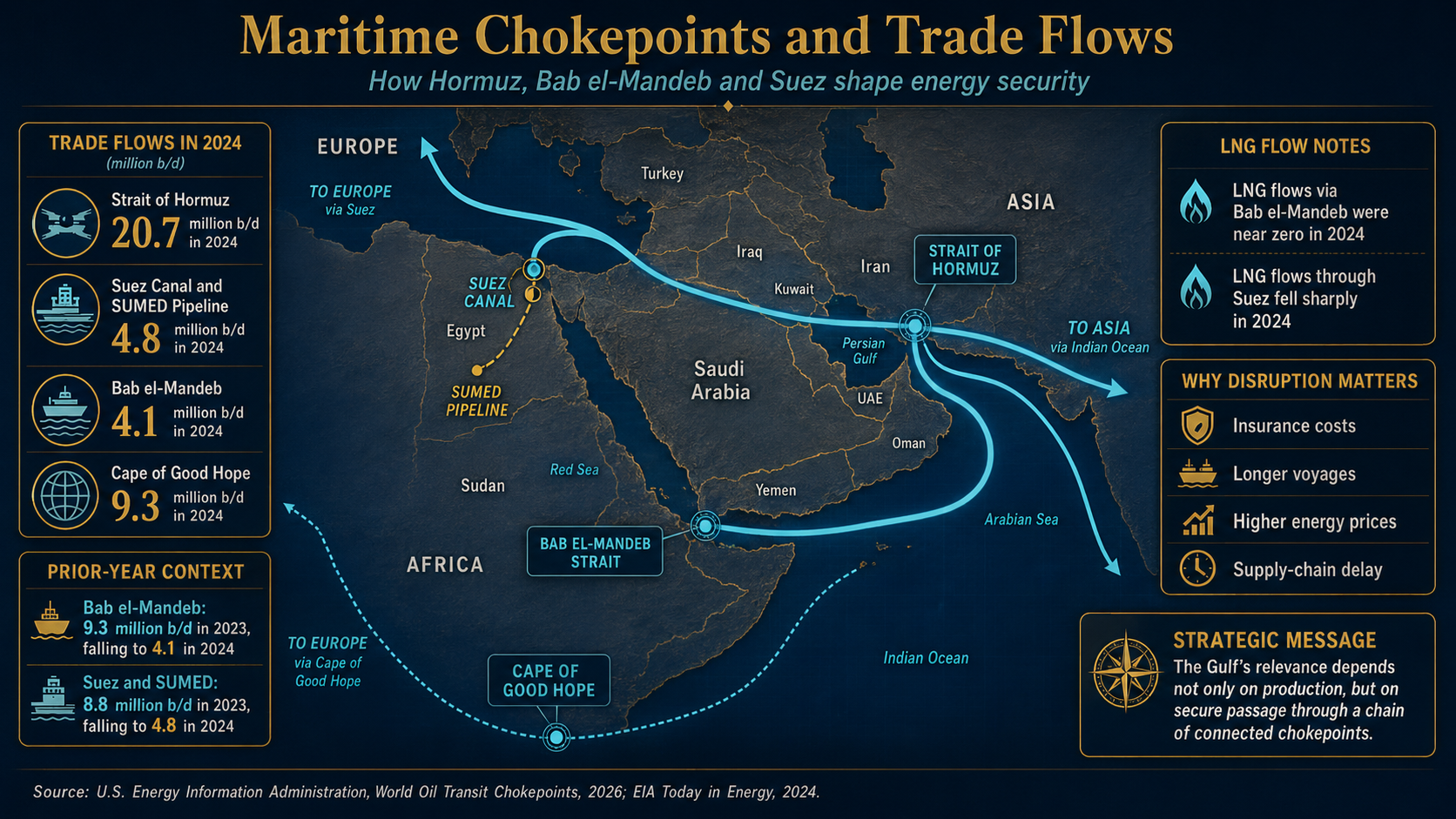
The Strait of Hormuz is the Gulf’s defining maritime chokepoint. EIA describes Hormuz as one of the world’s most important oil chokepoints and estimates that 20.7 million barrels per day of crude oil and petroleum liquids moved through it in 2024. The strait is narrow, but it carries volumes that affect global energy prices. If Hormuz were disrupted, there are limited alternatives for moving oil and LNG out of the Persian Gulf. Saudi Arabia, the UAE and others have some bypass infrastructure, but not enough to replace all flows from the Gulf.
Visual 3. Maritime chokepoints and trade flows. This map belongs in the chokepoints section because it compares Hormuz, Suez/SUMED, Bab el-Mandeb and the Cape of Good Hope route with 2024 flow figures and prior-year context.
Bab el-Mandeb and Suez are different but connected. They matter because Gulf exports to Europe and the Atlantic basin often move through the Red Sea route. EIA’s 2026 chokepoint analysis shows that total oil flows through Bab el-Mandeb fell from 9.3 million b/d in 2023 to 4.1 million b/d in 2024. Suez Canal and SUMED Pipeline flows fell from 8.8 million b/d in 2023 to 4.8 million b/d in 2024. EIA links this reduction to attacks on commercial shipping in the Red Sea after November 2023, which encouraged some vessels to reroute around the Cape of Good Hope. The Cape of Good Hope route carried 9.3 million b/d in 2024, reflecting how disruption in one maritime zone can redirect flows to a much longer pathway.
For FutureWorld analysis, this means a Gulf report cannot stop at Hormuz. The Gulf’s maritime exposure is a chain: Hormuz, Gulf of Oman, Arabian Sea, Bab el-Mandeb, Red Sea, Suez/SUMED, Mediterranean and sometimes the Cape of Good Hope. The risk is not only closure. Even partial disruption, insurance risk, vessel avoidance, naval escalation or delays can create global consequences. The strategic issue is resilience: how much redundancy exists, how quickly routes can be adjusted, and how much cost is transferred to consumers, insurers, shippers and governments.
Ports, logistics and trade routes
From hydrocarbon terminals to global logistics platforms
Ports are the physical interface between resource power and global systems. Ras Tanura, Jubail, Ras Laffan, Jebel Ali, Fujairah and Duqm are not only places on a map; they are nodes in a wider energy-logistics architecture. Ras Tanura and Jubail connect Saudi hydrocarbon production to export and industrial capacity. Ras Laffan supports Qatar’s LNG export system. Jebel Ali connects the UAE to container trade, re-export markets, aviation and logistics services. Fujairah matters because it lies outside the Strait of Hormuz on the Gulf of Oman. Duqm matters because it provides Oman with an Arabian Sea logistics base.
Visual 4. Port and logistics reading of the same Gulf strategic map. The ports marked on the map should be read as logistics nodes, not only geographic labels.
UNCTAD’s Review of Maritime Transport notes that around 80% of world goods trade by volume moves by sea. This makes maritime logistics a foundation of globalization. Gulf ports benefit from their location between Europe, Asia and Africa, but they also face exposure to chokepoint risks. A port’s value rises when it connects energy, containers, industry, finance, shipping services and inland logistics. This is why the Gulf’s diversification strategies often include ports, free zones, aviation hubs, industrial parks, digital infrastructure and tourism. These investments attempt to convert resource revenue into systems capacity.
The Gulf’s logistics future will depend on three connected shifts. First, maritime security will determine whether shipping remains predictable. Second, industrial diversification will determine whether ports handle only exports or become hubs for value-added production. Third, digital infrastructure will determine whether the region can link logistics with data, finance, AI, customs, ports and supply-chain management. In strategic terms, the future Gulf port is not only a harbor. It is a platform that connects energy, goods, capital, data and security.
State capability and sovereign wealth
Turning resource revenue into national capacity
State capability is the ability to convert resources into organized power. In the Gulf, this conversion is visible in sovereign wealth funds, infrastructure, cities, ports, airports, industrial zones, digital services, education reforms and defense spending. Hydrocarbon revenue gives states capital, but capital by itself is not capacity. Capacity emerges when investment creates institutions, skills, diversified industries, resilient infrastructure, research capability and public trust.
Saudi Arabia, the UAE, Qatar, Kuwait, Oman and Bahrain represent different models of conversion. Saudi Arabia has scale, population, religious significance, industrial ambition and the region’s only G20 membership. The UAE has built a logistics-finance-services model with high global connectivity. Qatar has used LNG and diplomacy to build influence beyond its size. Kuwait has fiscal strength and institutional history. Oman emphasizes strategic location, diplomacy and Indian Ocean access. Bahrain has long positioned itself as a financial and refining hub. Each model has strengths and constraints.
The long-term question is whether Gulf states can sustain influence if global oil demand changes, climate policy tightens, or energy transition accelerates. The answer will depend on how effectively they diversify into finance, logistics, petrochemicals, hydrogen, renewables, critical minerals processing, tourism, education, AI infrastructure and regional mediation. The Gulf’s advantage is that it has capital, location and strategic attention. Its challenge is to convert these into durable human and institutional capacity.
FutureWorld rule: do not measure Gulf power only by barrels. Measure energy, logistics, finance, institutions, technology, diplomacy, human capital and resilience together.
Security and alliances
Balancing partnerships in a multipolar system
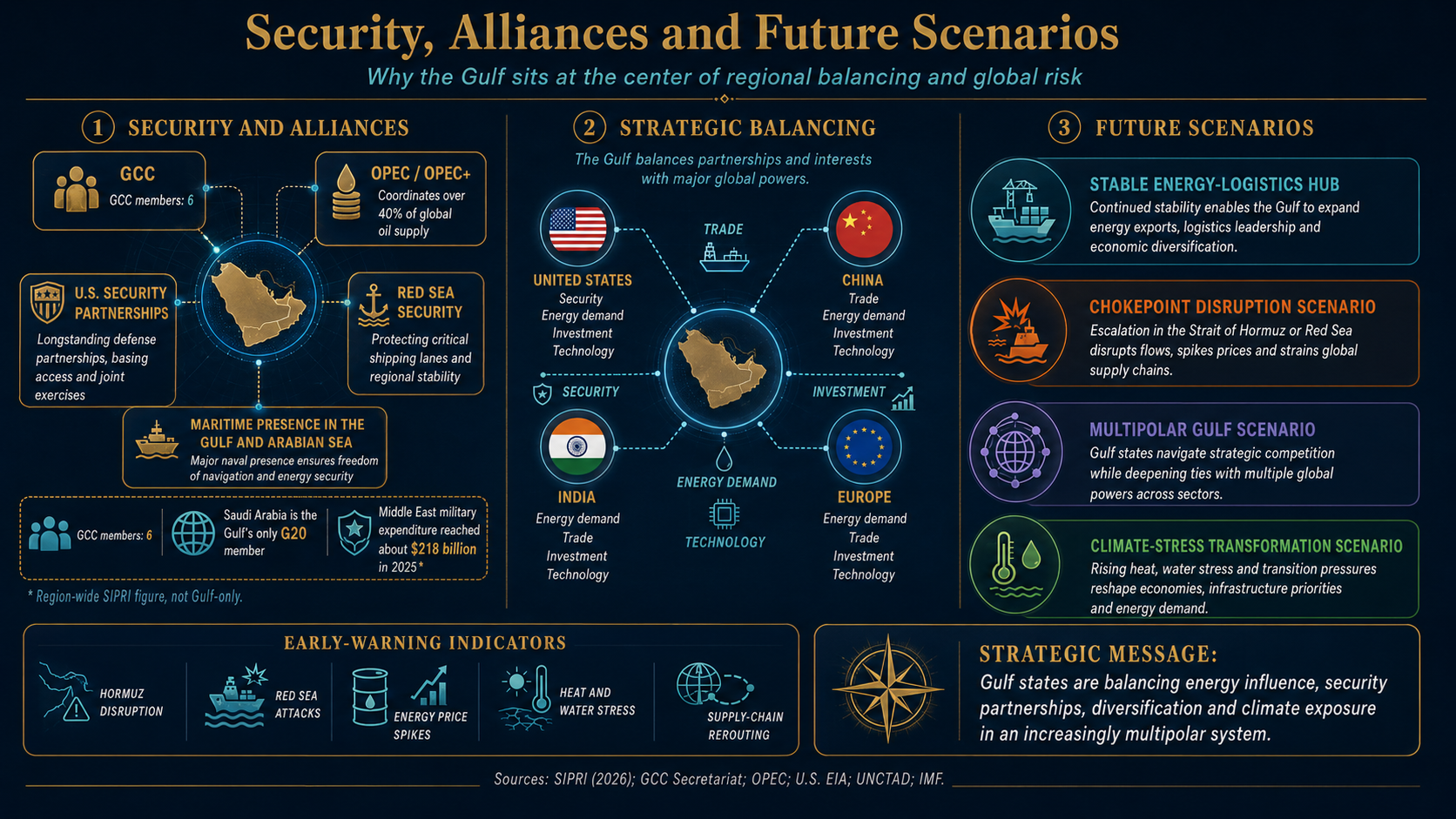
The Gulf’s security architecture is layered. At the regional level, the Gulf Cooperation Council provides a framework for cooperation among six members: Saudi Arabia, UAE, Qatar, Kuwait, Oman and Bahrain. At the energy level, OPEC and OPEC+ connect several Gulf producers to global oil supply management. At the security level, U.S. partnerships, military facilities, naval presence and joint exercises remain important for maritime security and deterrence. At the global level, Gulf states maintain expanding relationships with China, India, Europe, Russia, Japan, South Korea and other partners.
Visual 5. Security, alliances and future scenarios. This chart belongs in the security section because it links GCC, OPEC/OPEC+, U.S. partnerships, Red Sea security, major-power balancing and Gulf future scenarios.
This creates a multipolar balancing strategy. The United States remains central to security, but China is central to trade and energy demand. India matters through energy consumption, labor flows, investment and Indian Ocean connectivity. Europe matters through diplomacy, technology, investment, regulation and energy transition. Gulf states are not simply choosing one side. They are building portfolios of relationships because their interests are diversified across security, energy, finance, technology and logistics.
Security risks remain real. Hormuz disruption, Red Sea attacks, missile or drone escalation, cyber incidents, maritime insurance spikes and regional conflict can all affect the Gulf’s economic role. The SIPRI 2026 update reported that Middle East military expenditure reached about $218 billion in 2025, a region-wide figure that reflects continuing security pressures. Gulf states invest heavily in defense and security partnerships because their economies depend on stability, export routes and investor confidence. The region’s vulnerability is not only military; it is systemic. A security incident can quickly become an energy, shipping, financial and diplomatic incident.
International law and maritime rules
Legal order around sovereignty, passage and conflict
Law matters because it separates legal rights from political claims and military facts. The UN Charter provides the core framework for sovereignty, non-use of force, peaceful settlement of disputes and Security Council responsibility. UNCLOS provides the basic law of the sea framework for maritime zones, passage rights, territorial seas, exclusive economic zones and high seas freedoms. International humanitarian law becomes relevant if armed conflict affects ships, ports, civilians, infrastructure or military targets.
For the Gulf, the legal layer appears in several ways. The Strait of Hormuz raises questions of navigation and passage. The Persian Gulf includes maritime boundaries, territorial waters and offshore resources. Red Sea and Bab el-Mandeb insecurity raises questions of protection of commercial shipping, naval operations, self-defense claims and the law governing armed conflict. Sanctions and export controls add another legal-economic layer. Energy contracts, insurance rules, shipping registration, port state control and environmental rules also influence behavior.
Theory lens
Realism, sea power, geo-economics and climate security
Several theories help explain the Gulf. Realism highlights security competition, deterrence, military presence, alliance management and uncertainty. Sea power theory highlights why ports, chokepoints, naval access and shipping lanes are central. Geo-economics explains how oil, LNG, investment, sanctions, sovereign wealth, infrastructure and currency flows become instruments of influence. Liberal institutionalism explains why GCC, OPEC/OPEC+, WTO rules, climate frameworks and diplomatic forums matter. Constructivism explains identity, legitimacy, religious geography, national visions and diplomatic narratives. Climate-security theory helps assess heat, water, food-import dependence, coastal infrastructure and adaptation.
No single lens is sufficient. If the report uses only realism, it may overstate military conflict and understate trade and institutions. If it uses only economics, it may ignore security and law. If it uses only climate analysis, it may miss power politics and energy markets. FutureWorld’s strength should be lens discipline: use multiple theories, compare their insights, and test them against data.
FutureWorld method
G-D-T-L-S applied to the Gulf
Step
Question
Gulf application
G — Geography
Where are the routes, chokepoints, ports, borders and resource zones?
Map Hormuz, Gulf of Oman, Arabian Sea, Bab el-Mandeb, Suez/SUMED, Ras Tanura, Jubail, Ras Laffan, Jebel Ali, Fujairah and Duqm.
D — Data
What figures define the system?
Use EIA chokepoint oil flows, LNG flows through Hormuz, UNCTAD maritime transport statistics, SIPRI military expenditure and IMF/World Bank economic indicators.
T — Theory
Which lenses explain behavior?
Use sea power for chokepoints, realism for security, geo-economics for energy finance, liberal institutionalism for GCC/OPEC, and climate security for future stress.
L — Law
What legal frameworks apply?
Use UN Charter, UNCLOS, maritime passage rules, trade law, sanctions frameworks and international humanitarian law where conflict is involved.
S — Scenario
What pathways are plausible?
Stable hub, chokepoint disruption, multipolar Gulf, or climate-stress transformation.
FutureWorld practice: every future Gulf update should include one map, one route-flow chart, one energy-capability chart, one law/security layer and one scenario matrix.
Scenario pathways
Four futures for the Gulf system
1. Stable energy-logistics hub
In this pathway, the Gulf remains politically stable enough to expand LNG, crude exports, petrochemicals, ports, aviation, finance and tourism. Maritime security remains manageable, energy buyers continue to trust Gulf suppliers, and diversification projects improve state capacity. This scenario depends on de-escalation channels, stable shipping insurance, predictable regulation and continued investment in logistics and human capital.
2. Chokepoint disruption scenario
In this pathway, escalation in the Strait of Hormuz, Red Sea or Bab el-Mandeb disrupts shipping. The result may be higher insurance costs, rerouting, longer voyages, delayed cargoes, energy price volatility and pressure on consumers. This scenario does not require a full closure. Partial risk, repeated attacks or uncertainty can be enough to affect markets.
3. Multipolar Gulf scenario
In this pathway, Gulf states continue to balance between the United States, China, India, Europe and emerging blocs. Security relationships remain partly Western, while trade and energy demand shift increasingly toward Asia. The Gulf becomes a diplomatic marketplace where multiple global powers seek influence, investment and access.
4. Climate-stress transformation scenario
In this pathway, heat, water stress, coastal vulnerability, food-import dependence, energy transition and adaptation costs reshape priorities. Gulf states invest more in water technology, cooling systems, renewables, resilient infrastructure and climate diplomacy. Climate stress does not remove geopolitics; it adds a new layer to it.
Early-warning indicators
What FutureWorld should monitor
Hormuz indicators
Naval incidents, threats to shipping, tanker seizures, mine risk, missile alerts, insurance changes and unusual vessel rerouting.
Red Sea indicators
Attacks on commercial shipping, naval escort operations, Suez volume changes, Bab el-Mandeb flows and Cape of Good Hope rerouting.
Energy market indicators
Oil price spikes, LNG spot price movements, export terminal disruptions, OPEC+ decisions and Asian demand shifts.
Financial indicators
Sovereign wealth investments, debt stress, currency pressure, project delays and changes in foreign direct investment.
Climate indicators
Extreme heat, water desalination stress, coastal flooding, food import pressure, electricity demand and adaptation finance.
Technology indicators
Cyber incidents, AI/data-center energy demand, satellite reliance, port automation and digital infrastructure vulnerabilities.
Conclusion
The Gulf will remain strategic, but the source of strategy is changing
The Gulf’s importance is often described through oil, but oil is only the beginning. The region is strategic because of the combination of energy, geography, finance, logistics, security and diplomacy. Hormuz links Gulf energy to the world. Bab el-Mandeb and Suez link Gulf exports to Europe and the Atlantic basin. Asian demand links the Gulf to China, India, Japan and South Korea. Sovereign wealth links Gulf capital to global investment. Ports link the Gulf to supply chains. Climate stress links the Gulf to future resilience. Security partnerships link it to global power competition.
The report’s central finding is that the Gulf is moving from a hydrocarbon-centered model toward a systems-power model. Hydrocarbons remain crucial, but influence increasingly depends on how well states convert energy revenue into institutions, logistics, technology, finance, human capacity and resilience. The energy transition will not make the Gulf irrelevant. It will test whether the region can transform before its old model weakens. FutureWorld should therefore continue to study the Gulf not only as an oil basin, but as a strategic laboratory of multipolarity, maritime risk, energy transition and state-capability conversion.
References
Sources and data notes
U.S. Energy Information Administration. World Oil Transit Chokepoints, 2026. Includes 2024 and 1H25 oil transit figures for Hormuz, Suez/SUMED, Bab el-Mandeb and Cape of Good Hope. Open source.
U.S. Energy Information Administration. Amid regional conflict, the Strait of Hormuz remains critical oil chokepoint. June 2025. Open source.
U.S. Energy Information Administration. About one-fifth of global liquefied natural gas trade flows through the Strait of Hormuz. June 2025. Open source.
U.S. Energy Information Administration. Fewer tankers transit the Red Sea in 2024. October 2024. Open source.
UN Trade and Development. Review of Maritime Transport 2025 and annual maritime transport statistics. Open source.
Stockholm International Peace Research Institute. Global military spending rise continues as European and Asian expenditures surge, 2026. Open source.
International Monetary Fund. World Economic Outlook database and regional economic reporting. Open source.
World Bank. World Development Indicators. Open source.
Gulf Cooperation Council Secretariat. Official GCC information portal. Open source.
OPEC. Official OPEC information portal and oil market materials. Open source.
United Nations. Charter of the United Nations, Chapter I. Open source.
United Nations. United Nations Convention on the Law of the Sea. Open source.
Editorial note: This FutureWorld report is an original educational synthesis. Figures are drawn from cited institutional sources and used for public-interest educational analysis. Visuals are original report graphics based on the data and strategic structure of the report.